About 117 minutes
A Madeira Party — Key Ideas to Explore
Adventure Picaresque Fiction
26,868 recorded words. 15 minutes difference from this book's estimate.
View Gutenberg source #43242
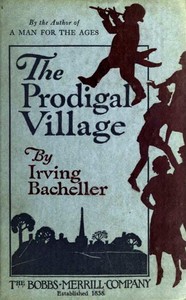
The source record for The Prodigal Village: A Christmas Tale — Key Ideas to Explore measures this digital text at 30,190 words, 2 hr 12 min estimated reading time, and 3 detected text sections.
The text analysis averages about 14.5 words per sentence, while the detected sections provide another way to judge how the source is divided.
Project Gutenberg metadata also associates the work with “Fiction,” connecting these edition facts with the source record’s subject description.
Explore this collection
These alternatives are selected using recorded categories and estimated reading time.
About 117 minutes
Adventure Picaresque Fiction
26,868 recorded words. 15 minutes difference from this book's estimate.
View Gutenberg source #43242About 90 minutes
Adventure Picaresque Fiction
20,608 recorded words. 42 minutes difference from this book's estimate.
View Gutenberg source #46591About 183 minutes
Adventure Picaresque Fiction
41,909 recorded words. 51 minutes difference from this book's estimate.
View Gutenberg source #46720Search stored excerpts and compare books → Choose by your preferences →
Choices use stored catalog measurements. Estimates vary with reading speed. A shared category is a catalog label, not a claim that two books have the same argument or literary quality.
Search reads excerpt text stored with this catalog and links to its associated Gutenberg record. The connection is stored in the site database; this tool does not recheck that every excerpt is word-for-word identical to that external record. Excerpt search does not cover every chapter and does not verify historical publication dates.
Catalog snapshot checked: 2026-09-26. Coverage: 98 public books, 98 available source excerpts.
Calculated from edition completeness, EPUB availability, text structure and catalogue metadata. Not a user rating.
Total of 100 points, scaled to a 2.5-5.0 range. Editions with an empty description or a missing EPUB file are not scored.
Public-domain source text
The source text is kept in the dedicated reader, separate from this catalogue record and its commentary.
The novel opens not with a sleigh ride but with a car wreck: Henry Smix, a slow-witted villager, “embraced Gasoline Power” and was hurled against a telegraph pole after his brief partnership with a motor vehicle scattered citizens and demolished a fence. The accident sets a tone of comic mishap with serious undertones—the small boy run over is Robert Emmet Moran, six-year-old son of the Widow Moran, a laundress. Bacheller’s narrator, adopting the voice of a local historian, treats the event with mock solemnity, noting that “Mr. Smix and his neighbor’s fence could be repaired but not the small boy.” This blend of folksy humor and genuine concern for a child’s fate establishes the book’s central tension: the clash between old-fashioned village life and the disruptive forces of modernity, all framed within a Christmas story that questions what true prosperity means.
The title character, introduced in chapter one, is Robert Emmet Moran, called “the Shepherd of the Birds” because he tends to injured birds. But the excerpts reveal a more active role: he has been “knitting night and day for the soldiers without hope of reward” and spent his savings on yarn. This detail—a boy knitting for soldiers during wartime—anchors the story’s moral center. Judge Crooker later praises the boy’s face as having “the old spirit of youth,” contrasting it with the “new look in the faces of the young” corrupted by evil pictures in the local theater. The boy’s quiet industry stands against the idle prosperity of men like Israel Sneed, who initially resists volunteering for wood-cutting. Bacheller uses the boy as a living rebuke to selfishness, a motif reinforced by the widow’s unpaid overtime at her washboard.
Judge Crooker emerges as the voice of communal conscience. In a committee meeting, he delivers a stern lecture to Mr. Sneed, who had complained about working men: “In America, we are all workers! The idle man is a mere parasite.” He lists the unpaid labor of doctors, ministers, and the widow, then asks, “Are we all going money mad?” His solution is direct: “grab our saws and axes and go out into the woods and make some fuel.” The Judge’s language is plain and forceful, using repetition (“No charge for overtime”) and physical gesture (“his long, bony forefinger pointing straight at Mr. Sneed”). This scene crystallizes the book’s critique of class division and its call for practical charity. The Judge’s authority comes not from office but from his willingness to chop wood alongside others.
Chapter three’s title, “Which Tells of the Complaining Coin and the Man Who Lost His Self,” hints at a fable-like subplot. The excerpts do not reveal the coin’s complaint, but the phrase suggests a critique of materialism. Meanwhile, the “man who lost his self” may connect to the subplot involving Mr. Sneed’s son Richard, who with three other boys has been “committing small burglaries and storing their booty in a cave.” Judge Crooker learns of this private matter, and his earlier warning about evil “pictures” in the theater implies a generational anxiety. The cave and the stolen goods echo the “prodigal” theme—waste and return. Bacheller weaves these threads into a Christmas story where redemption is communal, not individual, and where the village must recover not just fuel but its moral bearings.
Readers should attend to Bacheller’s narrative voice, which shifts between dry humor, sentimentalism, and outright sermonizing. The book’s episodic structure—each chapter a titled vignette—invites browsing, but the moral argument builds cumulatively. Pay particular attention to the contrast between the opening car crash and the closing Christmas scenes: the journey from “smixed up” to reconciled is the tale’s true arc. The excerpts offer only fragments of the burglary plot and the coin’s complaint; the full resolution awaits.
I keep thinking about how Bingville’s folks found peace in small, patient gestures — the boy’s knitting, the shepherd’s quiet watch. It reminded me of another old story, The Room with the Tassels — Background and Themes, where a similar hush settles over strange happenings. Both feel like rooms where time slows, letting you notice what truly matters.
Build a private reading journal entry for this title.