About 312 minutes
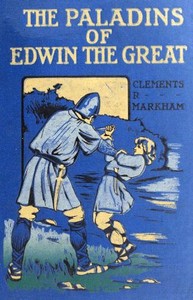
The Paladins of Edwin the Great — Key Ideas to Explore
Adventure Picaresque Fiction
71,574 recorded words. 2 minutes difference from this book's estimate.
View Gutenberg source #45543
The catalog record for Some Persons Unknown — A Reader’s Guide provides practical reading context through 72,186 words, 5 hr 14 min estimated reading time, and 8 detected text sections.
The text analysis averages about 16.7 words per sentence, while the detected sections provide another way to judge how the source is divided.
Project Gutenberg metadata also associates the work with “English fiction -- 19th century,” connecting these edition facts with the source record’s subject description.
Explore this collection
These alternatives are selected using recorded categories and estimated reading time.
About 312 minutes
Adventure Picaresque Fiction
71,574 recorded words. 2 minutes difference from this book's estimate.
View Gutenberg source #45543About 330 minutes
Adventure Picaresque Fiction
75,800 recorded words. 16 minutes difference from this book's estimate.
View Gutenberg source #45622About 334 minutes
Adventure Picaresque Fiction
76,619 recorded words. 20 minutes difference from this book's estimate.
View Gutenberg source #44220Search stored excerpts and compare books → Choose by your preferences →
Choices use stored catalog measurements. Estimates vary with reading speed. A shared category is a catalog label, not a claim that two books have the same argument or literary quality.
Search reads excerpt text stored with this catalog and links to its associated Gutenberg record. The connection is stored in the site database; this tool does not recheck that every excerpt is word-for-word identical to that external record. Excerpt search does not cover every chapter and does not verify historical publication dates.
Catalog snapshot checked: 2026-09-26. Coverage: 98 public books, 98 available source excerpts.
Calculated from edition completeness, EPUB availability, text structure and catalogue metadata. Not a user rating.
Total of 100 points, scaled to a 2.5-5.0 range. Editions with an empty description or a missing EPUB file are not scored.
Public-domain source text
The source text is kept in the dedicated reader, separate from this catalogue record and its commentary.
The collection opens with 'Kenyon's Innings,' a story that immediately establishes a voice attuned to the restless energy of childhood. The prose mirrors the boy's volatility: sentences are short, verbs active ('shrieking,' 'straddle,' 'bothered'), and the perspective shifts between Ethel's exasperation and John's grudging affection. The narrative pace is breathless, matching Kenyon's 'unsafe state all day.'
This initial domestic scene—a garden, a gable, a potting-shed—belies the collection's later turn toward colonial crime and moral ambiguity. Hornung's language adapts: where Kenyon's story uses physical danger as a proxy for grief, later tales like 'After the Fact' employ a clipped, urgent dialogue to convey psychological pressure. The voice remains consistent in its attention to small, telling details—soil on a windowsill, a voice that 'was not real'—but the pace accelerates from the leisurely cricket of the opening to the taut, breathless confessions of the deck-house.
The first story confines itself to a single estate: the garden wall, the greenhouses, the gable. The danger is physical, the stakes a boy's broken bones. By the time we reach 'After the Fact,' the setting has expanded to a bank in Geelong, a schooner, and a beach at Queenscliff. The language follows suit. In 'Kenyon's Innings,' the narrator describes a boy 'small and delicate and weak in everything but spirit'; the tone is fond, almost indulgent. In 'After the Fact,' the same narrator—now a character named Bower—reports a woman's confession with a stark, unadorned urgency: 'I knew he had done it; I can't tell you how I knew, but know I did.'
The pace changes accordingly. The early story lingers on a single day, building tension through repeated small crises. The later story compresses a bank robbery, a pursuit, and a confrontation into a few pages of dialogue. The sentences grow shorter, the paragraphs more fragmented. Where Kenyon's narrative had room for 'lovable looks' and 'astonishing brightness,' the later voice strips away ornament, leaving only the raw mechanics of guilt and desperation.
Hornung's narrators are not always trustworthy, and the collection exploits this. In 'Kenyon's Innings,' the third-person perspective is limited to Ethel and John; we never enter Kenyon's mind. His motives remain opaque—'there were reasons why he should not go to school'—and the story's sympathy is earned through action, not introspection. In 'After the Fact,' the first-person narrator Bower is both participant and observer, but his account is filtered through his own biases. He admits to having been 'at school together' with the villain, and his reactions are colored by that history.
The most striking shift occurs in the woman's confession. Her speech is a torrent of self-justification and self-blame: 'I made a fool of myself. You must have heard about it in Geelong. Well, it's quite true; but it wasn't yesterday.' The repetition and hedging reveal a mind struggling to control a narrative that is slipping away. Hornung's ear for the rhythms of guilt—the false starts, the defensive clarifications—gives the passage a psychological density absent from the earlier, more straightforward adventure. The voice becomes a tool of concealment as much as revelation.
The collection's pacing is not uniform; it varies with the moral weight of each story. 'Kenyon's Innings' moves at a child's tempo—quick bursts of excitement, long stretches of boredom. The prose is loose, allowing for digressions about 'snob-cricket' and the gardener's opinion. In 'After the Fact,' the pace is relentless. The woman's confession is a single, unbroken paragraph, punctuated only by dashes and exclamations: 'Oh, I know I was a fool to believe or listen to a word he said! I should have had him put in prison at the first.'
This acceleration reflects a world where consequences are irreversible. Kenyon's scrapes are forgiven; the bank robber's crimes are not. Hornung uses pace to signal genre: the early story is a comedy of manners, the later a thriller. But the shift is not merely technical. The faster pace in 'After the Fact' creates a sense of claustrophobia, of options narrowing. The deck-house scene, with its slammed door and 'evil mouth,' leaves no room for the leisurely resolutions of the opening. The language itself becomes a cage.
Readers attentive to Hornung's craft will notice how he calibrates voice and pace to match the moral temperature of each story. The collection rewards those who track these shifts: the same author who can spend a page on a boy's 'mania for walking round the entire premises on the garden wall' can later compress a woman's ruin into a single, breathless sentence. Pay attention to the moments when the prose slows—or speeds up—and ask what that change reveals about the characters' control over their own stories.
I kept thinking about how Hornung’s voice tightens as the stakes climb, almost like a held breath. There’s a quiet shelf-mate in The Last Entry — Reading Notes that carries that same lingering unease, though softer. It reminded me of closing a diary and feeling the room change, not dramatically, just enough to notice.
Create a short personal record of your experience with this book.