About 209 minutes
Great Porter Square: A Mystery. v. 2 — Edition Insights
Adventure Picaresque Fiction
47,959 recorded words. 26 minutes difference from this book's estimate.
View Gutenberg source #42906
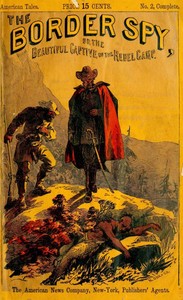
This digital edition of The Border Spy; or, The Beautiful Captive of the Rebel Camp A Story of the War — Key Ideas to Explore is described by source-level measurements including 41,909 words, 3 hr 3 min estimated reading time, and 5 detected text sections.
The text analysis averages about 12.8 words per sentence, while the detected sections provide another way to judge how the source is divided.
Project Gutenberg metadata also associates the work with “United States -- History -- Civil War, 1861-1865 -- Fiction,” connecting these edition facts with the source record’s subject description.
Explore this collection
These alternatives are selected using recorded categories and estimated reading time.
About 209 minutes
Adventure Picaresque Fiction
47,959 recorded words. 26 minutes difference from this book's estimate.
View Gutenberg source #42906About 215 minutes
Adventure Picaresque Fiction
49,398 recorded words. 32 minutes difference from this book's estimate.
View Gutenberg source #46160About 222 minutes
Adventure Picaresque Fiction
51,046 recorded words. 39 minutes difference from this book's estimate.
View Gutenberg source #44546Search stored excerpts and compare books → Choose by your preferences →
Choices use stored catalog measurements. Estimates vary with reading speed. A shared category is a catalog label, not a claim that two books have the same argument or literary quality.
Search reads excerpt text stored with this catalog and links to its associated Gutenberg record. The connection is stored in the site database; this tool does not recheck that every excerpt is word-for-word identical to that external record. Excerpt search does not cover every chapter and does not verify historical publication dates.
Catalog snapshot checked: 2026-09-26. Coverage: 98 public books, 98 available source excerpts.
Calculated from edition completeness, EPUB availability, text structure and catalogue metadata. Not a user rating.
Total of 100 points, scaled to a 2.5-5.0 range. Editions with an empty description or a missing EPUB file are not scored.
Public-domain source text
The source text is kept in the dedicated reader, separate from this catalogue record and its commentary.
The novel opens with General Price alone on a rocky precipice above the Osage River, his hand on his sword and his words full of resolve. The setting—a wild, elevated spot—immediately establishes a landscape of surveillance and vulnerability. Price’s soliloquy is interrupted by a man named Johnson, whose first word is “revenge.” Their exchange crackles with mutual suspicion: Price clutches his sword, Johnson questions whether the cause is Price’s or the country’s. This early scene, drawn from the first chapter, sets a pattern of tense confrontations and double meanings that runs through the excerpts.
From the opening dialogue, characters constantly test each other’s allegiance. Price demands assurance of Johnson’s faithfulness; Johnson deflects with a laugh. Later, Margrave asks Johnson, “Have you never entertained any suspicion that my sister was with Price?”—a question that echoes the novel’s central anxiety: who can be trusted? The word “treacherous” appears early, and characters repeatedly clutch weapons or demand proof. Even the Indian Fall-leaf, when asked if he can walk, replies “Me walk—well!” as if his physical capability must be asserted against doubt. This verbal sparring, where every statement carries a subtext of threat, gives the prose a clipped, urgent rhythm.
The Osage River, mountain oaks, and prairie are not mere backdrops but active elements in the plot. Characters move along “a narrow path” by the riverbank, hide horses among trees, and cross streams under fire. The description of the rebel camp is minimal; instead, the narrative focuses on routes of escape and concealment. When Margrave’s sister is rescued, the action is reported secondhand: “I saw her with two men, one of them disguised as a rebel officer… she is on her way to the Union camp.” The landscape becomes a network of possible hiding places and ambush points, reinforcing the story’s reliance on movement and evasion rather than static battle scenes.
Key events in the excerpts are conveyed through dialogue and after the fact. Margrave learns of his sister’s escape from Johnson, then later from Adjutant Hinton, whose account is interrupted by a terrified slave named George. Each retelling adds new details but also new uncertainties: Hinton says the party was scattered, the captain killed or wounded, and Alibamo last seen riding for the river. The novel withholds full clarity—George’s terror prevents a coherent report, and Hinton’s grief clouds his narrative. This technique of layered, incomplete information keeps the reader in a state of partial knowledge, mirroring the characters’ own confusion.
Readers should pay attention to how quickly alliances shift and how often characters speak at cross-purposes. The novel’s brevity—a dime novel of about 42,000 words—means that every exchange carries weight. The excerpts suggest a story driven by dialogue and movement rather than interior reflection. Those interested in Civil War popular fiction will find a fast-paced example of how suspense was built through suspicion, landscape, and fragmented storytelling.
There’s something about Margrave’s watchful patience in The Border Spy that lingers, that quiet scanning of every face for the truth beneath. It reminded me of another kind of waiting, the slower unraveling in The Curved Blades — Reading Companion. Different wars, perhaps, but the same ache of wondering whom you can trust when the evening grows long and the shadows start moving.
Create a short personal record of your experience with this book.