About 222 minutes
The Last Entry — Reading Notes
Adventure Picaresque Fiction
51,046 recorded words. 31 minutes difference from this book's estimate.
View Gutenberg source #44546
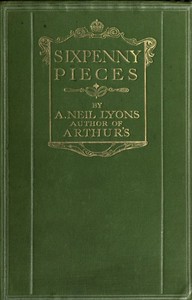
This digital edition of Sixpenny Pieces — Inside the Classic is described by source-level measurements including 57,972 words, 4 hr 13 min estimated reading time, and 10 detected text sections.
The text analysis averages about 12.2 words per sentence, while the detected sections provide another way to judge how the source is divided.
Project Gutenberg metadata also associates the work with “Physicians -- Fiction,” connecting these edition facts with the source record’s subject description.
Explore this collection
These alternatives are selected using recorded categories and estimated reading time.
About 222 minutes
Adventure Picaresque Fiction
51,046 recorded words. 31 minutes difference from this book's estimate.
View Gutenberg source #44546About 289 minutes
Adventure Picaresque Fiction
66,372 recorded words. 36 minutes difference from this book's estimate.
View Gutenberg source #46008About 215 minutes
Adventure Picaresque Fiction
49,398 recorded words. 38 minutes difference from this book's estimate.
View Gutenberg source #46160Search stored excerpts and compare books → Choose by your preferences →
Choices use stored catalog measurements. Estimates vary with reading speed. A shared category is a catalog label, not a claim that two books have the same argument or literary quality.
Search reads excerpt text stored with this catalog and links to its associated Gutenberg record. The connection is stored in the site database; this tool does not recheck that every excerpt is word-for-word identical to that external record. Excerpt search does not cover every chapter and does not verify historical publication dates.
Catalog snapshot checked: 2026-09-26. Coverage: 98 public books, 98 available source excerpts.
Calculated from edition completeness, EPUB availability, text structure and catalogue metadata. Not a user rating.
Total of 100 points, scaled to a 2.5-5.0 range. Editions with an empty description or a missing EPUB file are not scored.
Public-domain source text
The source text is kept in the dedicated reader, separate from this catalogue record and its commentary.
The book opens not with a character but with a tableau: a beautiful May evening in Bovingdon Street, where a lover kicks his sweetheart. This jarring juxtaposition of pastoral cliché and street violence sets the tone for a work that moves between the coffee stall, the sixpenny surgery, and the homes of the poor. The narrator, a young journalist, is drawn into the orbit of Dr. Brink, a round little man in a top hat who claims the bruised woman as his patient. The scene establishes a pattern of abrupt shifts—from laughter to whining, from whistle to constabulary—that recurs throughout the episodes.
The sixpence itself is a recurring token. It appears in chapter titles ('On Earning Sixpence,' 'Sixpences') and in the transactions that structure encounters. The fee is both a barrier and a bond; it marks the boundary between charity and commerce, and between the doctor's world and the patients'.
The narrative is punctuated by collective voices. In the opening, 'some of us laughed and some of us whined and one of us blew a whistle.' Later, the crowd follows the doctor and narrator as they escort the woman home, 'all the cut-throats of Bovingdon Street following reverently behind us.' These anonymous groups act as a Greek chorus, commenting on action through laughter, silence, or sudden movement. The crowd is also a source of pressure: when Mr. Boyle becomes famous, the public transforms him into a 'solemn National fact,' and the narrator notes how the same people who joked about him now regard levity as silly. The book repeatedly shows how collective attention shifts—from the street brawl to the celebrity, from the injured woman to the 'hero' of the cordite works.
The narrative moves restlessly between locations: the coffee stall, the surgery, the street, the home, the workplace. Each chapter or vignette typically begins with a change of scene, often signaled by a character's arrival or departure. The journey from the stall to the woman's home is described as a procession, with the crowd following 'reverently.' Later, the narrator visits Mr. Boyle at the surgery, then imagines his stage career at the Shoreditch Hippodrome. This constant motion reflects the precarious mobility of the poor—shifting between work, home, and public space—and the doctor's own itinerant practice. The book's structure, with its many short titled sections, mirrors this restlessness: no single location holds for long.
The narrator's tone is consistently ironic, undercutting sentiment with flat observation. When the woman says ''E done it in drink,' the response is not outrage but a matter-of-fact recording of the constable's removal of the man. Mr. Boyle's repeated 'funny thing' about his trouser and sock becomes a refrain that deflates the horror of the explosion. The doctor's own language is blunt: 'Shift your dam carcases and give the woman some air.' This verbal style extends to the narrative voice, which describes a 'beautiful' evening only to undercut it with violence. The effect is a kind of deadpan humor that refuses to moralize, leaving the reader to register the gap between event and response. The book does not explain or justify; it presents, and moves on.
Readers should approach Sixpenny Pieces as a series of linked sketches rather than a continuous plot. The narrator's role as observer, not protagonist, means that attention shifts unpredictably. Pay attention to the recurring motifs—coins, crowds, the doctor's top hat—and to the way the book uses contrast (beauty and brutality, fame and obscurity) to structure its episodes. The work rewards those who read for texture and tone rather than narrative arc.
That afternoon, the rain drummed against the windows while I sat with Sixpenny Pieces, and the narrator’s quiet reckoning with Dr. Brink’s weary generosity stayed with me long after I closed it. Idly tracing that same feeling of hidden rooms and delicate transactions, my hand drifted to the shelf and pulled down The Room with the Tassels — Background and Themes, finding a similar hush between its pages. Just like that, one afternoon turned into two.
Save your reaction, strongest insight, and memorable passage.