About 314 minutes
Some Persons Unknown — A Reader’s Guide
Adventure Picaresque Fiction
72,186 recorded words. 2 minutes difference from this book's estimate.
View Gutenberg source #45732
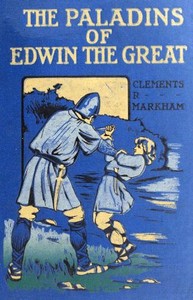
The catalog record for The Paladins of Edwin the Great — Key Ideas to Explore provides practical reading context through 71,574 words, 5 hr 12 min estimated reading time, and 8 detected text sections.
The text analysis averages about 19.1 words per sentence, while the detected sections provide another way to judge how the source is divided.
Project Gutenberg metadata also associates the work with “Great Britain -- History -- Anglo-Saxon period, 449-1066 -- Fiction,” connecting these edition facts with the source record’s subject description.
Explore this collection
These alternatives are selected using recorded categories and estimated reading time.
About 314 minutes
Adventure Picaresque Fiction
72,186 recorded words. 2 minutes difference from this book's estimate.
View Gutenberg source #45732About 330 minutes
Adventure Picaresque Fiction
75,800 recorded words. 18 minutes difference from this book's estimate.
View Gutenberg source #45622About 334 minutes
Adventure Picaresque Fiction
76,619 recorded words. 22 minutes difference from this book's estimate.
View Gutenberg source #44220Search stored excerpts and compare books → Choose by your preferences →
Choices use stored catalog measurements. Estimates vary with reading speed. A shared category is a catalog label, not a claim that two books have the same argument or literary quality.
Search reads excerpt text stored with this catalog and links to its associated Gutenberg record. The connection is stored in the site database; this tool does not recheck that every excerpt is word-for-word identical to that external record. Excerpt search does not cover every chapter and does not verify historical publication dates.
Catalog snapshot checked: 2026-09-26. Coverage: 98 public books, 98 available source excerpts.
Calculated from edition completeness, EPUB availability, text structure and catalogue metadata. Not a user rating.
Total of 100 points, scaled to a 2.5-5.0 range. Editions with an empty description or a missing EPUB file are not scored.
Public-domain source text
The source text is kept in the dedicated reader, separate from this catalogue record and its commentary.
Markham opens The Paladins of Edwin the Great with a preface that reads like a lecture on Anglo-Saxon settlement, detailing dates, dragon ships, and the migration from Angeln. This scholarly tone gives way to a story that begins in Stillingfleet, a Yorkshire village, where the narrative pace is unhurried, focused on domestic life. But the kidnapping of Porlor and his companion by sea-thieves, illustrated in the frontispiece, signals a sudden lurch into adventure. The book’s structure—three parts titled Home, Exile, and Work—mirrors this shift from the local to the global, as the boys are swept from England to Rome and then to Persia.
Markham’s prose oscillates between dry historical exposition and melodramatic adventure. In the preface, he writes of “the coming of the Englishmen to England” with the detachment of a historian, listing dates and regions. Yet in the kidnapping episode, the language becomes urgent: “We are too late!” exclaims Porlor. “We must follow quickly to Rome.” The narrator often steps back to explain context—such as the fate of Symmachus’s widow—then plunges into dialogue and action. This dual register gives the book an uneven texture, as if Markham cannot decide whether he is writing a textbook or a boys’ own story.
The narrative pace is tied to geography. In the Home section, time moves slowly, with scenes of storytelling and daily life. Once the boys are kidnapped, the pace accelerates: they sail, scheme, and chase Mystacon across the Mediterranean. The excerpt from the rescue of Sivel shows a rapid sequence of deduction, preparation, and departure: “Their preparations were soon made. Next day the captain and crew were on board.” Yet Markham pauses for consultations and descriptions of Roman villas. These shifts can feel abrupt, as when a six-year gap is mentioned in a single sentence: “Six years had passed since the mortifying scene in the slave-market.”
Kidnapping and rescue form the book’s central engine. The frontispiece shows Porlor and his companion “kidnapped by sea-thieves,” and later Mystacon kidnaps Sivel. The boys respond with a cry: “To the rescue! to the rescue!” The motif recurs in the chapter titles: “Kidnapped,” “In Bondage at Rome,” “The Rescue of Sivel.” Markham emphasizes the boys’ agency—they rack their brains, make plans, and fund their own voyages. Yet the narrative also relies on coincidences, such as Lilla catching sight of Mystacon in a crowd. This pattern of capture and pursuit drives the plot but can feel repetitive across the book’s 71,000 words.
Readers should expect a hybrid work: part historical primer on Anglo-Saxon England, part adventure serial with a young cast. Markham’s formal voice and digressions into background may slow the action, but the kidnapping plot provides momentum. The book rewards attention to its geographical sweep—from Yorkshire to Rome to Persia—and to the way Markham uses captivity to test his characters’ resourcefulness. Approach it as a period piece that reflects late-Victorian interests in empire, migration, and boyhood heroism.
Reading about those boys torn from Yorkshire and carried toward Rome stirred something old in me—my own childhood summers of hiding behind hedges, pretending the graveyard was Persia. I remember feeling that same quiet ache of displacement in There She Blows! Or, The Log of the Arethusa — Themes and Context, where the sea swallows home and leaves only horizon behind. Strange how distance makes memory glow warmer.
Capture what you thought, learned, and would like to remember.