About 402 minutes
"Tex" — Reading Companion
Adventure Picaresque Fiction
92,344 recorded words. 38 minutes difference from this book's estimate.
View Gutenberg source #43100
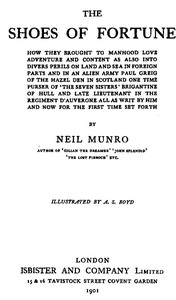
The Shoes of Fortune — Background and Themes can be approached with a clearer sense of reading commitment from its source measurements: 101,053 words, 7 hr 20 min estimated reading time, and 11 detected text sections.
The text analysis averages about 21.4 words per sentence, while the detected sections provide another way to judge how the source is divided.
Project Gutenberg metadata also associates the work with “Adventure stories,” connecting these edition facts with the source record’s subject description.
Explore this collection
These alternatives are selected using recorded categories and estimated reading time.
About 402 minutes
Adventure Picaresque Fiction
92,344 recorded words. 38 minutes difference from this book's estimate.
View Gutenberg source #43100About 388 minutes
Adventure Picaresque Fiction
89,033 recorded words. 52 minutes difference from this book's estimate.
View Gutenberg source #46390About 377 minutes
Adventure Picaresque Fiction
86,696 recorded words. 63 minutes difference from this book's estimate.
View Gutenberg source #48095Search stored excerpts and compare books → Choose by your preferences →
Choices use stored catalog measurements. Estimates vary with reading speed. A shared category is a catalog label, not a claim that two books have the same argument or literary quality.
Search reads excerpt text stored with this catalog and links to its associated Gutenberg record. The connection is stored in the site database; this tool does not recheck that every excerpt is word-for-word identical to that external record. Excerpt search does not cover every chapter and does not verify historical publication dates.
Catalog snapshot checked: 2026-09-26. Coverage: 98 public books, 98 available source excerpts.
Calculated from edition completeness, EPUB availability, text structure and catalogue metadata. Not a user rating.
Total of 100 points, scaled to a 2.5-5.0 range. Editions with an empty description or a missing EPUB file are not scored.
Public-domain source text
The source text is kept in the dedicated reader, separate from this catalogue record and its commentary.
The narrator, Paul Greig, opens his account with a meditation on chance, tracing his entire adventurous life to a single trivial event: an elderly woman burning her batch of scones. This wry, retrospective voice—self-aware and slightly rueful—sets the tone for a picaresque that is as much about the telling as the tale. Greig imagines alternative fates (sheriff, soured advocate) before embracing the hard, dangerous path he actually walked, from Scottish moorland to foreign armies. The opening chapter establishes a narrator who is both philosopher and fugitive, his story hinging on the unpredictable.
The novel’s first sentence declares chance “the one element to baffle the logician,” and the entire plot is presented as a cascade of contingencies. Greig traces his flight from Scotland to a woman’s neglected griddle, then to the blackguard skipper Dan Risk, a foreign jail, and unwitting complicity in a prince’s murder. This chain is not merely a plot device but a structural principle: each twist is framed as a consequence of small, overlooked moments. The narrator’s retrospective stance—looking back forty years—allows him to weigh what might have been against what was, lending the adventure a philosophical undertow. The reader is invited to see the story not as inevitable but as a series of forks taken by accident.
Greig’s narrative voice is distinctive: colloquial, self-deprecating, and capable of sharp moral judgment. In a prison cell exchange with Father Hamilton, a priest who attempted regicide, Greig refuses to soften the act with Latin: “give us the plain English of it, Father Hamilton, and call it murder.” The priest, in turn, deflects with wit and a reference to Greig’s own “unhappy affair,” revealing that both men are compromised. Their dialogue—full of interrupted sentences, gestures, and shifts from French to Scots—shows Munro’s skill at using speech to reveal character. Greig is no simple hero; he is a man who has connived at a prince’s murder, however unwittingly, and the novel does not let him forget it.
The excerpts move from a Scottish moorland parish to a French prison, each setting rendered with specific, sensory detail. The opening contrasts the “kent and friendly folk” of home with the “vile roads” and “common cart” of the later journey. The priest’s cell is described through small, telling details: a fire, snuff, dew-laps, a trembling hand. Munro uses place to underscore the narrator’s dislocation—from the familiar to the alien, from safety to peril. Even the title’s “Shoes of Fortune” hints at a journey undertaken on foot, in footwear that marks the wearer as fugitive or soldier. The physical world is never background; it is the medium through which chance operates.
Readers should attend to the interplay between Greig’s retrospective calm and the urgency of the events he describes. The novel rewards attention to its layered narration—what is said, what is withheld, and how the past is filtered through memory. Munro’s prose, salted with Scots and French, demands a patient ear, but the payoff is a picaresque with genuine moral weight.
I was thinking today about that moment in Munro’s The Shoes of Fortune when a single burnt scone quietly upends a life, and how fortune rarely arrives with a signpost. It reminded me of the curious shadows in Great Porter Square: A Mystery. v. 2 — Edition Insights, where chance seems to linger behind every doorway, waiting to be mistaken for design.
A brief reflection can help important ideas stay with you longer.