About 231 minutes
The Pastor's Fire-side Vol. 1 (of 4) — Context and Discussion
Science Fiction Utopias
52,996 recorded words. 0 minutes difference from this book's estimate.
View Gutenberg source #46570
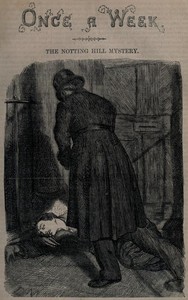
The source record for The Notting Hill Mystery — Context and Discussion measures this digital text at 52,951 words, 3 hr 51 min estimated reading time, and 5 detected text sections.
The text analysis averages about 16.7 words per sentence, while the detected sections provide another way to judge how the source is divided.
Project Gutenberg metadata also associates the work with “Detective and mystery stories,” connecting these edition facts with the source record’s subject description.
Explore this collection
These alternatives are selected using recorded categories and estimated reading time.
About 231 minutes
Science Fiction Utopias
52,996 recorded words. 0 minutes difference from this book's estimate.
View Gutenberg source #46570About 244 minutes
Science Fiction Utopias
55,973 recorded words. 13 minutes difference from this book's estimate.
View Gutenberg source #43727About 269 minutes
Science Fiction Utopias
61,702 recorded words. 38 minutes difference from this book's estimate.
View Gutenberg source #46787Search stored excerpts and compare books → Choose by your preferences →
Choices use stored catalog measurements. Estimates vary with reading speed. A shared category is a catalog label, not a claim that two books have the same argument or literary quality.
Search reads excerpt text stored with this catalog and links to its associated Gutenberg record. The connection is stored in the site database; this tool does not recheck that every excerpt is word-for-word identical to that external record. Excerpt search does not cover every chapter and does not verify historical publication dates.
Catalog snapshot checked: 2026-09-26. Coverage: 98 public books, 98 available source excerpts.
Calculated from edition completeness, EPUB availability, text structure and catalogue metadata. Not a user rating.
Total of 100 points, scaled to a 2.5-5.0 range. Editions with an empty description or a missing EPUB file are not scored.
Public-domain source text
The source text is kept in the dedicated reader, separate from this catalogue record and its commentary.
The Notting Hill Mystery opens with a direct address to the reader, warning that the case will require 'a very close attention to names and dates' to follow the compiler's argument. The story is framed as a report from private investigator R. Henderson to a life assurance association, detailing his inquiry into the death of Madame R**, whose husband, Baron R**, held multiple policies totaling £25,000. The narrative immediately establishes a documentary structure: letters, medical notes, and testimonies are presented as evidence, and the reader is told that some things 'which are dark at first will appear clearer in the sequel.' This is not a conventional detective story but a puzzle assembled from fragments, with the compiler himself uncertain of the outcome.
The book's opening section, titled 'The Case,' is a letter from Henderson to the insurance secretary, summarizing the circumstances that prompted the investigation. The first clue is a 'coincidence'—left unspecified—that led the companies to suspect fraud. Henderson then recapitulates the policies, all taken out within months of each other. The reader is immediately placed in the role of a juror, sifting through documents that include a doctor's diary, chemical analyses, and witness statements. The compiler admits that the evidence is circumstantial and 'somewhat difficult of acceptance,' especially if it reveals 'a new species or description of crime.' This framing invites skepticism: the narrator is not omniscient but a fallible investigator presenting a case.
A key excerpt comes from the attending physician, who describes Madame R**'s recurring attacks of gastritis. He notes that the symptoms resembled 'chronic antimonial poisoning' as recorded in medical literature, and he delicately raised the possibility of foul play with the Baron. The Baron initially seemed 'almost amused' but later cooperated in analyzing medicines and excretions for arsenic and antimony. The tests found nothing. The doctor admits he relied on the Baron's expertise as a chemist, stating, 'I did not take any special pains to ascertain the purity of the chemical tests employed.' This detail is crucial: the investigation's integrity hinges on the very suspect. The reader must weigh the doctor's trust against the possibility of deception.
George Du Maurier's illustrations are mentioned in the preface as being 'simply added to make the reader's task more agreeable,' but the text notes they were not made simultaneously with the events. This disclaimer hints that the images may not be reliable evidence—they are artistic interpretations, not documents. In a story built on documentary proof, the illustrations occupy an ambiguous space. They might offer visual clues or merely decorate. The reader should consider whether the pictures align with the written testimony or introduce contradictions. Du Maurier, later famous for Trilby, brings a distinctive visual style to this early detective serial.
The narrative is filtered through Henderson's perspective, but the excerpts reveal gaps. He confesses he 'could still have wished a more satisfactory result,' and the evidence is incomplete. The doctor's diary shows that Madame R** nearly died in October 1856 but recovered, only to die later in an 'unfortunate accident.' The exact cause of death is not given in these excerpts. The reader must track dates, names, and the chain of custody for evidence. Henderson's report is a construction, not a transparent account. Pay attention to what is omitted: the Baron's motives, the nature of the 'accident,' and the possibility that the compiler himself may be misled.
As you read, keep a notebook for names and dates—the compiler insists on this. The mystery unfolds through layers of testimony, each with its own bias. The doctor trusts the Baron; the Baron controls the chemistry; the investigator relies on both. The truth may lie not in any single document but in the contradictions between them. This is a story that rewards rereading and suspicion.
I kept returning to the way The Notting Hill Mystery makes you hold onto tiny details—a date, a name—like loose threads in a coat pocket. It reminded me of a quiet afternoon with A Rainy June, and Other Stories — Themes and Context, where the ordinary hours felt weighted with something unsaid. Both books ask patience of you, and I was glad to give it.
A brief reflection can help important ideas stay with you longer.