About 300 minutes
White Wolf's Law: A Western Story — Key Ideas to Explore
Science Fiction Utopias
68,991 recorded words. 1 minutes difference from this book's estimate.
View Gutenberg source #46457
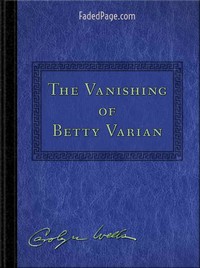
This digital edition of The Vanishing of Betty Varian — Text and Context is described by source-level measurements including 69,089 words, 5 hr 1 min estimated reading time, and 10 detected text sections.
The text analysis averages about 14.3 words per sentence, while the detected sections provide another way to judge how the source is divided.
Project Gutenberg metadata also associates the work with “Detective and mystery stories,” connecting these edition facts with the source record’s subject description.
Explore this collection
These alternatives are selected using recorded categories and estimated reading time.
About 300 minutes
Science Fiction Utopias
68,991 recorded words. 1 minutes difference from this book's estimate.
View Gutenberg source #46457About 305 minutes
Science Fiction Utopias
70,063 recorded words. 4 minutes difference from this book's estimate.
View Gutenberg source #42944About 291 minutes
Science Fiction Utopias
66,851 recorded words. 10 minutes difference from this book's estimate.
View Gutenberg source #46958Search stored excerpts and compare books → Choose by your preferences →
Choices use stored catalog measurements. Estimates vary with reading speed. A shared category is a catalog label, not a claim that two books have the same argument or literary quality.
Search reads excerpt text stored with this catalog and links to its associated Gutenberg record. The connection is stored in the site database; this tool does not recheck that every excerpt is word-for-word identical to that external record. Excerpt search does not cover every chapter and does not verify historical publication dates.
Catalog snapshot checked: 2026-09-26. Coverage: 98 public books, 98 available source excerpts.
Calculated from edition completeness, EPUB availability, text structure and catalogue metadata. Not a user rating.
Total of 100 points, scaled to a 2.5-5.0 range. Editions with an empty description or a missing EPUB file are not scored.
Public-domain source text
The source text is kept in the dedicated reader, separate from this catalogue record and its commentary.
The novel opens with a detailed portrait of Headland Harbor, a summer colony on the Maine coast where artists and idlers gather. The description emphasizes the wild, rocky landscape and the community's self-conscious exclusivity: residents would never admit finer golf links exist elsewhere. This setting, with its "deep black waters" and "storm-swept" cliffs, establishes a contrast between serene summer leisure and the violent events to come.
When Pennington Wise arrives with his assistant Zizi—described as a "strange, almost weird little girl creature"—the tone shifts. Zizi immediately takes charge at the crime scene, examining the servant Martha's body and noting a "dark green streak" across her palm. This detail, along with her quick deductions about Martha's actions, signals that the mystery will hinge on physical evidence and sharp observation rather than mere deduction.
The opening chapter establishes Headland Harbor as a place of deliberate contradictions. The community prides itself on valuing "good nature and an amusing personality" over wealth or genius, yet the narrative also notes that "wealth counted for what it was worth." This careful social balancing act creates a setting where appearances matter deeply. The harbor itself is described as "wind-swept and often storm-swept to a wild picturesqueness," a far cry from the peaceful image the word "harbor" typically evokes. This tension between expectation and reality mirrors the central mystery: a young woman vanishes from a place that seems safe and orderly.
The colony's inhabitants include artists and "the less talented" seeking fishing or idleness, suggesting a range of motives and capabilities among potential suspects. The clubhouse verandah, crowded at noon for mail delivery, becomes a stage for social observation. Wells uses this setting to hint that beneath the surface of summer camaraderie, rivalries and secrets may fester.
Pennington Wise's assistant Zizi is introduced as a disruptive force. She darts through the house, demands tea from the cook, and immediately kneels to examine Martha's body—actions that unsettle the household. Her dialogue is sharp and commanding: "Wait!" she orders the sheriff, insisting Wise see the body before it's removed. Zizi's observations are precise: she notes Martha's disheveled appearance—"clad only in a kimono, over her nightdress"—and deduces that the victim must have been certain she heard a burglar, not Mrs. Varian, to risk coming downstairs again.
Her scrutiny of Martha's hands reveals the "dark green streak" that becomes a key clue. Zizi's approach contrasts with the local authorities' desire to dismiss Martha's death as unrelated to Betty's disappearance. She treats physical evidence as paramount, even as others rely on assumptions. This focus on tangible details—bruises, clothing, stains—grounds the investigation in the material world, resisting the temptation to theorize without proof.
When Pennington Wise arrives, the narrative shifts to describe him through the sheriff's eyes. Bill Dunn, the local authority, initially "sniffed to see that he was a mere human being after all." But Dunn quickly recognizes Wise's "air of efficiency" and "subtle hint of power." Wells emphasizes that Wise gives "an instant impression of sure reasoning and inerrant judgment" without any self-assertion. This characterization sets up a contrast between the methodical, observant detective and the more impulsive local investigators.
Wise's first action is to examine Martha's body at Zizi's insistence, suggesting a partnership where Zizi's instincts guide his attention. The scene also introduces the tension between treating the two crimes—Betty's disappearance and Martha's murder—as connected or separate. Dunn argues they are unrelated, but Wise's willingness to investigate both suggests a more integrated approach. The reader is left to weigh the evidence: the green stain, the timing, and the household dynamics.
Readers should pay close attention to physical details—the green stain, the yellow pillow mentioned in the chapter list, the Varian pearls—as Wells embeds clues in objects and settings rather than in dialogue alone. The narrative voice shifts between omniscient description and limited perspectives, so note who is present when key observations are made. The contrast between the colony's cultivated leisure and the violence that disrupts it is not merely atmospheric; it may reflect deeper tensions among the characters.
I’ve shelved both for decades, and they sit differently on the heart. The green stain on Betty’s palm in the Varian case always felt like moss creeping into a neat parlor—the way summer light in Maine can hide a chill. Old Batchel’s parish knows that same still, uneasy quiet, where a whisper from The Stoneground Ghost Tales Compiled from the recollections of the Reverend Roland Batchel, Vicar of the parish. — Inside the Classic lingers like dust on a windowsill. Two countries, one shared breath held between pages.
Use these questions to collect your thoughts before moving on.