About 377 minutes
Back o' the Moon, and other stories — Text and Context
Adventure Picaresque Fiction
86,696 recorded words. 11 minutes difference from this book's estimate.
View Gutenberg source #48095
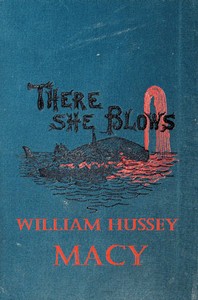
The catalog record for There She Blows! Or, The Log of the Arethusa — Themes and Context provides practical reading context through 89,033 words, 6 hr 28 min estimated reading time, and 11 detected text sections.
The text analysis averages about 21.3 words per sentence, while the detected sections provide another way to judge how the source is divided.
Project Gutenberg metadata also associates the work with “Whaling -- Fiction,” connecting these edition facts with the source record’s subject description.
Explore this collection
These alternatives are selected using recorded categories and estimated reading time.
About 377 minutes
Adventure Picaresque Fiction
86,696 recorded words. 11 minutes difference from this book's estimate.
View Gutenberg source #48095About 402 minutes
Adventure Picaresque Fiction
92,344 recorded words. 14 minutes difference from this book's estimate.
View Gutenberg source #43100About 347 minutes
Adventure Picaresque Fiction
79,648 recorded words. 41 minutes difference from this book's estimate.
View Gutenberg source #47555Search stored excerpts and compare books → Choose by your preferences →
Choices use stored catalog measurements. Estimates vary with reading speed. A shared category is a catalog label, not a claim that two books have the same argument or literary quality.
Search reads excerpt text stored with this catalog and links to its associated Gutenberg record. The connection is stored in the site database; this tool does not recheck that every excerpt is word-for-word identical to that external record. Excerpt search does not cover every chapter and does not verify historical publication dates.
Catalog snapshot checked: 2026-09-26. Coverage: 98 public books, 98 available source excerpts.
Calculated from edition completeness, EPUB availability, text structure and catalogue metadata. Not a user rating.
Total of 100 points, scaled to a 2.5-5.0 range. Editions with an empty description or a missing EPUB file are not scored.
Public-domain source text
The source text is kept in the dedicated reader, separate from this catalogue record and its commentary.
The author’s preface declares this work is “not to be regarded as a mere ‘yarn’” but “a series of illustrated sketches of actual life on the ocean, made up of real incidents and introducing for the most part real characters.” Written by a blind Nantucket captain, the book follows the whaling voyage of the Arethusa through a sequence of chapters that move from Peck Slip to Nantucket Bar, then across the Atlantic and Pacific. The structure mimics a ship’s log, with each chapter marking a geographic or narrative stage—from “The First Whale” to “Cutting In” and “Boiling.”
The book’s chapter titles trace a literal voyage: “From Peck Slip to Nantucket Bar,” “In and Out over the Bar,” “From the Bar Round Great Point,” and so on. Each chapter functions as a log entry, anchored to a specific location or event. The narrative moves steadily westward—from the Western Islands to the Falklands, Juan Fernandez, the Marquesas, and Japan—before turning homeward. This geographic progression gives the episodic incidents a coherent trajectory, even when individual chapters focus on self-contained set pieces like a bill-fish attack or a prisoner escape.
A striking episode in Chapter XIV involves a bill-fish that impales itself on the ship’s bow while chasing bonitas. The fish’s bill breaks off “short up to his head,” and the crew speculates it may “caulk its own” hole. This image recurs thematically: the ship as a vessel that both receives and deflects violent impacts. Earlier, the author describes bonitas “gambolling ahead” of the ship, and the bill-fish’s attack is a sudden, almost suicidal collision. Such moments of abrupt physical contact—whale strikes, boat launches, man-overboard alarms—punctuate the log’s steady rhythm of sailing and processing.
The narrator’s voice is matter-of-fact, but the dialogue of characters like Jeff reveals sharp prejudices. Jeff, a sailor, recounts being betrayed by a “Cholo” who sold him for a bounty, concluding: “Gi’me white or black, I say; for where you mix ’em, you spile two good things.” This line, delivered with a “greenish kind of blush,” exemplifies how the book embeds racial attitudes within casual seafaring talk. The author does not comment on these views; they are presented as part of the “real characters” he claims to depict. The reader must weigh such moments against the narrator’s own observations.
The narrative often jumps between scenes with minimal transition: “Down the coasts of Chili and Peru we pursued our voyage, and then off-shore among the Galapagos.” These shifts mirror the logbook format, where weeks or months may pass between entries. The author acknowledges this by noting “No incident of note occurred during this pleasant cruise” before introducing a new event. This selective reporting means the reader experiences only the highlights—whale catches, near-disasters, encounters with other ships—while the long, uneventful stretches remain implied. The structure thus emphasizes the dramatic peaks of whaling life.
Readers should approach There She Blows! as a curated log rather than a continuous novel. The author’s blindness, mentioned in the preface, lends weight to his claim of recording “real incidents.” Pay attention to how the narrator’s voice shifts between observation and reported dialogue, and how the ship’s movement from port to port organizes the episodic material. The book rewards those who read for specific, vivid moments rather than overarching plot.
The rain drummed on the windows that day, and I remember losing myself in the logbook of the Arethusa, feeling the salt spray between those blind captain’s lines. That search for something beyond the horizon stayed with me, so I found myself, almost without thinking, drifting toward The Strange Voyage and Adventures of Domingo Gonsales, to the World in the Moon — Context and Discussion, another journey just as improbable, yet somehow just as real.
Use these questions to collect your thoughts before moving on.