About 276 minutes
The Smuggler's Cave — Story, Setting & Ideas
Historical Psychological Social Fiction
63,435 recorded words. 1 minutes difference from this book's estimate.
View Gutenberg source #44752
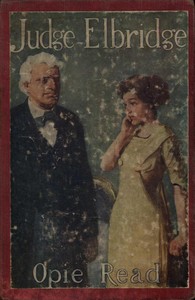
Judge Elbridge — Reading Companion can be approached with a clearer sense of reading commitment from its source measurements: 63,690 words, 4 hr 37 min estimated reading time, and 9 detected text sections.
The text analysis averages about 12.1 words per sentence, while the detected sections provide another way to judge how the source is divided.
Project Gutenberg metadata also associates the work with “Gambling -- Fiction,” connecting these edition facts with the source record’s subject description.
Explore this collection
These alternatives are selected using recorded categories and estimated reading time.
About 276 minutes
Historical Psychological Social Fiction
63,435 recorded words. 1 minutes difference from this book's estimate.
View Gutenberg source #44752About 268 minutes
Historical Psychological Social Fiction
61,447 recorded words. 9 minutes difference from this book's estimate.
View Gutenberg source #44464About 260 minutes
Historical Psychological Social Fiction
59,742 recorded words. 17 minutes difference from this book's estimate.
View Gutenberg source #45100Search stored excerpts and compare books → Choose by your preferences →
Choices use stored catalog measurements. Estimates vary with reading speed. A shared category is a catalog label, not a claim that two books have the same argument or literary quality.
Search reads excerpt text stored with this catalog and links to its associated Gutenberg record. The connection is stored in the site database; this tool does not recheck that every excerpt is word-for-word identical to that external record. Excerpt search does not cover every chapter and does not verify historical publication dates.
Catalog snapshot checked: 2026-09-26. Coverage: 98 public books, 98 available source excerpts.
Calculated from edition completeness, EPUB availability, text structure and catalogue metadata. Not a user rating.
Total of 100 points, scaled to a 2.5-5.0 range. Editions with an empty description or a missing EPUB file are not scored.
Public-domain source text
The source text is kept in the dedicated reader, separate from this catalogue record and its commentary.
The novel opens with a measured, almost biographical tone, recounting Judge Elbridge's retirement from the bench and his early partnership with the orator Bodney. The narrator describes Chicago's transformation from a mud-hole to a commercial palace, setting a retrospective mood. But this calm exposition soon gives way to sharp, rapid-fire exchanges between the Judge and his son Howard. The dialogue crackles with accusation and denial, as the Judge's anger manifests in trembling fingers and cutting remarks like 'Pledge me your old clothes, but not your honor.' The pace shifts abruptly from leisurely summary to tense, present-tense confrontation, a pattern that recurs throughout the excerpts.
The narrative voice in Judge Elbridge is not uniform. The opening chapter adopts a detached, almost historical register, describing Elbridge and Bodney as 'the student and the orator' and using metaphors like 'the years, like racing horses, flew round and round the track.' This reflective tone gives the reader a sense of distance. However, when the story moves into direct dialogue—as in the heated exchange between the Judge and Howard—the voice becomes immediate and visceral. The Judge's speech is peppered with rhetorical questions ('How can you deny it?') and physical gestures ('his finger shook, a willow in the wind'). The contrast between these two modes creates a rhythm of calm and storm, suggesting that the novel's emotional weight is carried by its confrontational scenes.
The pacing in the excerpts is deliberately uneven. Long, descriptive paragraphs that cover years of backstory are followed by compressed, almost real-time dialogues. For instance, the narrator summarizes decades of partnership and family history in a few sentences, then slows to a crawl for the argument about Dr. Risbin. This shift forces the reader to pay close attention to each line of dialogue. The Judge's interruptions—'Enough of that,' 'Don't speak of her'—further quicken the pace, creating a staccato effect. The result is a narrative that feels breathless during arguments and contemplative in between, a technique that mirrors the generational clash between the old, measured world of the Judge and the impatient modernity of his son.
Several specific details recur in the excerpts, each tied to the central conflict. The 'mud-hole' that became valuable property appears twice, first as a symbol of missed opportunity, later as a contrast to the 'musty old den' Howard wants to leave. The Judge's physical gestures—pointing, shaking a finger, raising shears—are repeated, emphasizing his volatile temper. Objects like the 'banner of the salvationists' and the 'old office' carry symbolic weight, representing the Judge's rigid values. These details are not merely decorative; they anchor the emotional stakes. The reader can trace the tension through these recurring motifs, which accumulate meaning as the story progresses.
Readers should attend to the rhythm of the prose: when the narrator steps back, the story breathes; when dialogue takes over, it tightens. The excerpts offer only a partial view, but the pattern of alternating pace and voice is consistent. Pay attention to how the Judge's physical reactions—the trembling finger, the raised shears—are described, as they often signal the emotional temperature of a scene more than the words themselves.
There are evenings when Judge Elbridge’s weary patience, watching his son’s new city tear at old certainties, feels like a hand resting on my shoulder. I find the same quiet ache in The House of Defence v. 1 — Context and Discussion, where arguing voices also hold a deeper loneliness. They are companions in that hush after a slammed door.
A brief reflection can help important ideas stay with you longer.