About 208 minutes
The House of Defence v. 2 — Inside the Classic
Historical Psychological Social Fiction
47,780 recorded words. 10 minutes difference from this book's estimate.
View Gutenberg source #45801
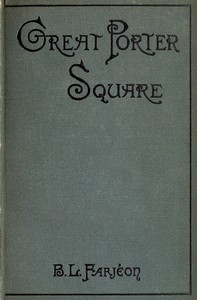
Great Porter Square: A Mystery. v. 3 — Background and Themes can be approached with a clearer sense of reading commitment from its source measurements: 45,334 words, 3 hr 18 min estimated reading time, and 5 detected text sections.
The text analysis averages about 16.5 words per sentence, while the detected sections provide another way to judge how the source is divided.
Project Gutenberg metadata also associates the work with “Fiction,” connecting these edition facts with the source record’s subject description.
Explore this collection
These alternatives are selected using recorded categories and estimated reading time.
About 208 minutes
Historical Psychological Social Fiction
47,780 recorded words. 10 minutes difference from this book's estimate.
View Gutenberg source #45801About 210 minutes
Historical Psychological Social Fiction
48,190 recorded words. 12 minutes difference from this book's estimate.
View Gutenberg source #43158About 177 minutes
Historical Psychological Social Fiction
40,606 recorded words. 21 minutes difference from this book's estimate.
View Gutenberg source #46124Search stored excerpts and compare books → Choose by your preferences →
Choices use stored catalog measurements. Estimates vary with reading speed. A shared category is a catalog label, not a claim that two books have the same argument or literary quality.
Search reads excerpt text stored with this catalog and links to its associated Gutenberg record. The connection is stored in the site database; this tool does not recheck that every excerpt is word-for-word identical to that external record. Excerpt search does not cover every chapter and does not verify historical publication dates.
Catalog snapshot checked: 2026-09-26. Coverage: 98 public books, 98 available source excerpts.
Calculated from edition completeness, EPUB availability, text structure and catalogue metadata. Not a user rating.
Total of 100 points, scaled to a 2.5-5.0 range. Editions with an empty description or a missing EPUB file are not scored.
Public-domain source text
The source text is kept in the dedicated reader, separate from this catalogue record and its commentary.
The third volume of Great Porter Square: A Mystery opens with a letter from Becky to Fanny, a narrative device that immediately establishes a confiding, conspiratorial tone. Becky describes her position in the household—treated “more like a lady than a servant” after lending money to her mistress—and her plan to use a child as an assistant. This domestic detail, set against the looming threat of arson, anchors the mystery in everyday transactions of trust and power.
The structure of the volume alternates between Becky’s first-person accounts, a diary, and third-person scenes of preparation for crime. The excerpts show a careful movement between spaces: from the servant’s room to the roof, then down into the ransacked room where a murder occurred. This vertical and horizontal traversal of the building becomes a recurring pattern, linking the characters’ physical movements to the unraveling of secrets.
Becky’s letters to Fanny are the primary narrative vehicle in the opening chapters. They are intimate, detailed, and self-aware: Becky notes that Mrs. Preedy “threw out a hint about taking me into partnership” if she invests her legacy. The letters reveal how financial leverage—Becky has lent forty pounds—shifts social dynamics within the house. She is treated “more like a lady than a servant,” yet she remains a servant, using her position to gather information.
The letters also show Becky’s strategic use of a child messenger, whom she describes as “steady, and bright, and clever.” This choice of a child as an agent underscores the theme of hidden observation: a child can move unnoticed where an adult might be suspected. The epistolary form allows Farjeon to present Becky’s calculations directly, without authorial commentary, making the reader complicit in her schemes.
When Grace enters the room where her husband was murdered, she finds it “so torn up, the work of destruction had been so wanton, that she could scarcely recognise it as the same room.” This description does more than set a scene; it signals how violence has rewritten the space. The room’s disorder offers Grace a strange relief—it is no longer the familiar site of domestic life, but a chaotic stage for new crime.
The passage emphasizes sensory details: the “tin can filled with pitch,” “small cans of inflammable oil,” and “a packet of gunpowder” are listed with clinical precision. The arsonist Pelham speaks of burning down “all Great Porter Square,” treating the neighborhood as a stage for profit. The room becomes a repository of both memory and menace, where the past murder and the planned fire converge.
Grace’s transformation into a “pretty boy” is described with a mixture of vanity and unease. She “took the greatest pleasure in making herself look as much as possible like a young man,” yet she drops a ring and an earring in the process—small objects that hint at the fragility of her disguise. The scene in the garret, with its “broken bit of looking-glass,” underscores the makeshift nature of her performance.
Richard Manx (alias Pelham) guides her across the roof and down into the next house, where she trembles. He warns her against showing “the white feather,” a phrase that links cowardice to the physical whiteness of fear. The disguise is not merely a plot device; it is a commentary on how identity is constructed through clothing, gesture, and the spaces one occupies. Grace’s pleasure in her disguise coexists with her terror, creating a tension that runs through the volume.
The narrative repeatedly traces paths between adjacent buildings: from No. 119 Great Porter Square to the next house, across roofs, and down through trap-doors. This architectural movement is not incidental; it structures the suspense. Pelham leads Grace “carefully over the roof, and down the trap-door, into the next house,” a journey that literalizes the hidden connections between lives.
The houses themselves become characters: No. 119 is let to a new tenant, and its empty rooms are used for storing incendiary materials. The Square is described as “pretty well deserted” on a bad night, making it a perfect stage for crime. Farjeon uses the physical layout of the neighborhood to create a sense of enclosure and exposure simultaneously—the characters are hidden yet vulnerable, moving through spaces that are both private and overlooked.
The volume’s reliance on letters, diaries, and shifting points of view means that the reader must piece together events from partial accounts. Pay attention to who is speaking and what they choose to reveal or conceal. The recurring image of the ransacked room—a space where past violence and future crime meet—offers a key to the novel’s method: every object and every room may hold a clue, but also a trap. The mystery lies not only in what happened, but in how the characters navigate the physical and social architecture of Great Porter Square.
Reading about Becky’s letters and the watchful shadows around Great Porter Square, I remembered sitting with my grandmother’s old diary, noticing how silence could hold more than speech. It felt like when I first opened Kingsworth; or, The Aim of a Life — Reading Notes — that same quiet ache of rooms where secrets had been lived in, not just hidden. Some books simply ask you to sit still with them.
Save your reaction, strongest insight, and memorable passage.