About 240 minutes
The Third Circle — Reading Notes
Historical Psychological Social Fiction
55,182 recorded words. 4 minutes difference from this book's estimate.
View Gutenberg source #48620
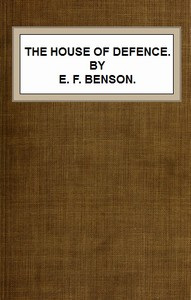
The catalog record for The House of Defence v. 1 — Context and Discussion provides practical reading context through 54,226 words, 3 hr 56 min estimated reading time, and 5 detected text sections.
The text analysis averages about 19.1 words per sentence, while the detected sections provide another way to judge how the source is divided.
Project Gutenberg metadata also associates the work with “England -- Social life and customs -- Fiction,” connecting these edition facts with the source record’s subject description.
Explore this collection
These alternatives are selected using recorded categories and estimated reading time.
About 240 minutes
Historical Psychological Social Fiction
55,182 recorded words. 4 minutes difference from this book's estimate.
View Gutenberg source #48620About 227 minutes
Historical Psychological Social Fiction
52,186 recorded words. 9 minutes difference from this book's estimate.
View Gutenberg source #46200About 245 minutes
Historical Psychological Social Fiction
56,237 recorded words. 9 minutes difference from this book's estimate.
View Gutenberg source #47426Search stored excerpts and compare books → Choose by your preferences →
Choices use stored catalog measurements. Estimates vary with reading speed. A shared category is a catalog label, not a claim that two books have the same argument or literary quality.
Search reads excerpt text stored with this catalog and links to its associated Gutenberg record. The connection is stored in the site database; this tool does not recheck that every excerpt is word-for-word identical to that external record. Excerpt search does not cover every chapter and does not verify historical publication dates.
Catalog snapshot checked: 2026-09-26. Coverage: 98 public books, 98 available source excerpts.
Calculated from edition completeness, EPUB availability, text structure and catalogue metadata. Not a user rating.
Total of 100 points, scaled to a 2.5-5.0 range. Editions with an empty description or a missing EPUB file are not scored.
Public-domain source text
The source text is kept in the dedicated reader, separate from this catalogue record and its commentary.
Benson opens The House of Defence with a scene of quiet domestic tension that quickly escalates into a high-stakes spiritual crisis. The narrative voice, initially measured and observant, tightens as Lady Maud confronts the possibility of losing Sandie. The healer's calm, assured speech contrasts sharply with Maud's inner turmoil, creating a rhythm of hesitation and resolve. Benson's prose becomes almost liturgical during the healer's silent prayer, where the description of 'calling his winged thoughts home' slows the pace to a meditative hush. This volume, published in 1907, reflects contemporary debates about faith healing and the limits of medical science, but Benson's focus remains on the psychological pressure of choice rather than doctrinal argument.
The healer's voice is marked by deliberate repetition and a refusal to claim personal power. He insists he is 'but the window through which the sun shines,' a metaphor he uses twice in the excerpt. His language is simple, almost childlike in its directness: 'Why, certainly I will.' Yet this simplicity carries immense weight. Benson underscores the healer's authority by having him overturn a glass 'to clear a little space' before praying—a small, decisive action that signals his control over the material world. The narrative lingers on his physical stillness, contrasting with Maud's 'dreadful indecision.' The healer's calm is not passive; it is an active, almost aggressive force that reshapes the scene's tempo.
Lady Maud's perspective dominates the excerpt, and Benson renders her conflict through visceral physical details. She 'did not know that the human face could hold such happiness' when the healer agrees to help, yet immediately she is 'terrified at her choice.' Her fear is not abstract: she imagines Sandie dying and her own responsibility. Benson uses short, fragmented sentences to convey her panic: 'What if Sandie died, and she had not sent for the doctor?' The narrative pace quickens here, mirroring her racing thoughts. But when the healer soothes her 'like a child,' the prose slows again, adopting his measured cadence. This oscillation between urgency and stillness defines the volume's emotional landscape.
The healer's silent prayer is the excerpt's structural and thematic center. Benson describes it in a single, sweeping sentence that mimics the act of concentration: 'he called his winged thoughts home, and they settled in his soul like homing doves.' The metaphor of polishing the window—'speckless of dust'—extends the earlier image of the healer as a conduit. The prayer itself is not quoted; instead, Benson focuses on the physical act of clearing the table and covering the eyes. This restraint heightens the scene's mystery. After the prayer, the healer's voice returns with biblical authority: 'you shall stand still and see the salvation of God.' The pace shifts from internal reflection to forward motion as Maud agrees to follow him upstairs.
Readers should attend to how Benson uses the healer's speech patterns—his repetitions, his metaphors of light and windows—to establish a counterpoint to Maud's more conventional, anxious voice. The volume's title, The House of Defence, may resonate with the healer's description of faith as a protective structure. Since this is only the first volume, the outcome of Sandie's illness remains unresolved, but the narrative's focus on the moment of decision rather than its consequences suggests that Benson is more interested in the psychology of belief than in plot mechanics.
Rereading The House of Defence reminded me of that quiet pull in Lady Maud’s hesitations—how faith and ordinary duty blur. It felt strangely familiar, like old marginalia in The Days of Auld Lang Syne — Reading Notes, where those same small choices linger between the lines. Both left me thinking about what we keep, even when we’re not sure why.
Use these questions to collect your thoughts before moving on.