About 392 minutes
The Imprudence of Prue — Background and Themes
Historical Psychological Social Fiction
90,080 recorded words. 2 minutes difference from this book's estimate.
View Gutenberg source #47305
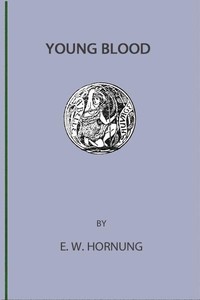
This digital edition of Young Blood — Story, Setting & Ideas is described by source-level measurements including 90,581 words, 6 hr 34 min estimated reading time, and 10 detected text sections.
The text analysis averages about 15.9 words per sentence, while the detected sections provide another way to judge how the source is divided.
Project Gutenberg metadata also associates the work with “Detective and mystery stories,” connecting these edition facts with the source record’s subject description.
Explore this collection
These alternatives are selected using recorded categories and estimated reading time.
About 392 minutes
Historical Psychological Social Fiction
90,080 recorded words. 2 minutes difference from this book's estimate.
View Gutenberg source #47305About 403 minutes
Historical Psychological Social Fiction
92,689 recorded words. 9 minutes difference from this book's estimate.
View Gutenberg source #46057About 384 minutes
Historical Psychological Social Fiction
88,190 recorded words. 10 minutes difference from this book's estimate.
View Gutenberg source #47378Search stored excerpts and compare books → Choose by your preferences →
Choices use stored catalog measurements. Estimates vary with reading speed. A shared category is a catalog label, not a claim that two books have the same argument or literary quality.
Search reads excerpt text stored with this catalog and links to its associated Gutenberg record. The connection is stored in the site database; this tool does not recheck that every excerpt is word-for-word identical to that external record. Excerpt search does not cover every chapter and does not verify historical publication dates.
Catalog snapshot checked: 2026-09-26. Coverage: 98 public books, 98 available source excerpts.
Calculated from edition completeness, EPUB availability, text structure and catalogue metadata. Not a user rating.
Total of 100 points, scaled to a 2.5-5.0 range. Editions with an empty description or a missing EPUB file are not scored.
Public-domain source text
The source text is kept in the dedicated reader, separate from this catalogue record and its commentary.
The novel opens with a rush of sensory detail: Harry Ringrose, just turned twenty-one, hurtles north by train after a voyage from Australia. Hornung establishes a restless, almost breathless pace through short clauses and exclamatory phrases—'the happiest morning of his life,' 'the glorious truth came home to him'—that mirror the protagonist's own impatience. The prose lingers on the contrast between the 'long lithe express' and the 'little clumsy local,' a pattern of scale and disparity that recurs throughout the excerpts.
Yet the narrative voice is not uniformly eager. When Harry later walks through Richmond, the tone cools into measured observation, noting the 'High Street seemed a lonely place' after a parting. This modulation between exhilaration and anticlimax becomes a structural habit, as Hornung repeatedly builds momentum only to undercut it with a deflating detail or a shift in register.
Hornung structures the opening around a series of arrivals that quickly sour or complicate. Harry's homecoming is framed as a triumph—'the happiest and the luckiest young rascal in the land'—but the chapter title 'The Old Home' and the subsequent 'Breaking of the News' signal that stability will be short-lived. The prose accelerates during travel sequences, with stations 'hailed and left behind' in a blur, then decelerates into domestic scenes where dialogue and introspection take over.
This pattern repeats in the London sections. A successful sale to Tommy Tiddler produces a moment of shared joy with Fanny Lowndes, but the conversation quickly pivots to her father's dubious Highland Crofters' Salmon and Trout Supply Association. The narrative voice shifts from celebratory to skeptical, especially in the dry enumeration of the company's name changes and patronage swaps. Hornung uses the rhythm of good news followed by qualification—'it was delightful… yet…'—to create a sense of precarious optimism.
The excerpts show that even minor victories are shadowed by practical worries. Harry's mother insists he apply for a poorly paid teaching post, and his own writing income is measured in half-sovereigns. The pace of the prose mirrors this seesaw: long, flowing sentences for hopeful moments, shorter, clipped ones for setbacks.
Hornung's narrator maintains a detached, slightly ironic stance toward the characters' self-deceptions. When Harry reflects on his 'spindle-legs' or calls himself a 'young rascal,' the phrasing carries a knowing wink that distances the reader from full sympathy. The same ironic lens applies to the financial schemes: the Highland Crofters' Salmon and Trout Supply Association is described with a straight face, yet the accumulation of names—'the Earl of Banff,' 'the Hon. Pelham Tankervell'—and the 'sheaf of most interesting letters' from 'illustrious persons' invites skepticism without stating it outright.
This voice is most evident in the treatment of Fanny Lowndes. Her 'gorgeous parasol' is presented as a symbol of newfound prosperity, but the narrator notes it was bought with 'the lawyers' cheque'—a detail that undercuts the glamour. Similarly, Harry's literary ambitions are treated with a mixture of encouragement and deflation: his verses are 'accepted contributions,' but the magazine is called Tommy Tiddler, a name that suggests triviality. The narrator never condemns, but the choice of detail creates a quiet comedy of misplaced hopes.
The excerpts also reveal a habit of indirect characterization through objects. Harry's mother knits socks while discussing his career; the letters from noblemen are handled as physical props. These small, concrete items anchor the irony in the material world.
Hornung varies his narrative speed by alternating between panoramic description and tight focus. The opening chapter moves rapidly across geography—from ship to train to platform to local line—with the prose mimicking the velocity of travel. Once Harry reaches home, the pace slows to accommodate domestic details: the 'early sun in his sleepy eyes,' the 'dear old English birds.' This zooming effect recurs in London, where a broad view of the Underground or the High Street gives way to intimate exchanges in a flat.
The most striking shift occurs in the financial subplot. The narrator races through the history of the Crofter Fisheries—its name changes, patrons, and letters—in a single dense paragraph, then halts for a quiet exchange between Harry and Fanny. The speed of the business summary contrasts with the slower, more tentative dialogue: 'But you believe in it now?' 'More than I did—decidedly.' This juxtaposition suggests that the novel's emotional core lies in the pauses between schemes.
Another notable deceleration happens when Harry receives the teaching offer. The letter is described as 'one more thin envelope,' and the salary is 'thirty pounds.' The prose becomes almost staccato: 'Very little also was the salary offered. It was thirty pounds.' This abrupt contraction of pace signals a moment of decision, where the narrative weight shifts from external action to internal conflict.
Readers attentive to Hornung's narrative craft will notice how he uses speed as a tool of characterization: Harry's impatience is rendered through rapid transitions, while his mother's caution emerges in slower, more deliberate scenes. The excerpts suggest a novel that rewards attention to these shifts in tempo, as well as to the ironic distance between what characters say and what the narrator implies. The financial schemes and literary aspirations are best understood not as separate plots but as parallel arenas where the same pattern of hope and deflation plays out.
That rainy afternoon, I kept returning to Hornung’s Harry, his schemes unravelling while the English fields stayed stubbornly green. It made me think of other restless souls. Later, almost by accident, I found myself turning pages of Caleb Wright: A Story of the West — A Closer Reading, and the same quiet ache of displacement seemed to follow me there.
Build a private reading journal entry for this title.