About 306 minutes
Bliss, and other stories — Reading Companion
Historical Psychological Social Fiction
70,186 recorded words. 1 minutes difference from this book's estimate.
View Gutenberg source #44385
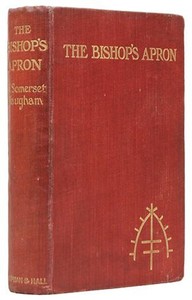
The source record for The Bishop's Apron: A study in the origins of a great family — Text and Context measures this digital text at 70,041 words, 5 hr 5 min estimated reading time, and 8 detected text sections.
The text analysis averages about 13.9 words per sentence, while the detected sections provide another way to judge how the source is divided.
Project Gutenberg metadata also associates the work with “Clergy -- England -- Fiction,” connecting these edition facts with the source record’s subject description.
Explore this collection
These alternatives are selected using recorded categories and estimated reading time.
About 306 minutes
Historical Psychological Social Fiction
70,186 recorded words. 1 minutes difference from this book's estimate.
View Gutenberg source #44385About 301 minutes
Historical Psychological Social Fiction
69,130 recorded words. 4 minutes difference from this book's estimate.
View Gutenberg source #43726About 315 minutes
Historical Psychological Social Fiction
72,278 recorded words. 10 minutes difference from this book's estimate.
View Gutenberg source #46621Search stored excerpts and compare books → Choose by your preferences →
Choices use stored catalog measurements. Estimates vary with reading speed. A shared category is a catalog label, not a claim that two books have the same argument or literary quality.
Search reads excerpt text stored with this catalog and links to its associated Gutenberg record. The connection is stored in the site database; this tool does not recheck that every excerpt is word-for-word identical to that external record. Excerpt search does not cover every chapter and does not verify historical publication dates.
Catalog snapshot checked: 2026-09-26. Coverage: 98 public books, 98 available source excerpts.
Calculated from edition completeness, EPUB availability, text structure and catalogue metadata. Not a user rating.
Total of 100 points, scaled to a 2.5-5.0 range. Editions with an empty description or a missing EPUB file are not scored.
Public-domain source text
The source text is kept in the dedicated reader, separate from this catalogue record and its commentary.
The novel opens not with a bishop but with his butler: Ponsonby, whose 'flabby and corpulent' frame and 'earnest, obsequious voice' make visitors glance at his calves for episcopal gaiters. This comic inversion sets the tone for a story in which clerical dignity is a performance. Canon Spratte, the actual clergyman, is introduced through his brother Lord Spratte, a middle-aged man who 'takes more care of his hands than a professional beauty' and uses 'numerous pots and jars and bottles' to deny his age. The catalog subjects list 'Clergy -- England -- Fiction' and 'Families -- Fiction,' but the excerpts focus less on pastoral work than on domestic theatre: luncheon arrangements, social calls, and the careful management of appearances.
Ponsonby, the butler, is described with language that parodies ecclesiastical dignity. His movements are 'measured and noiseless,' his face 'undisturbed by the rapid play of expression,' and his voice gives 'an impression of such overwhelming piety' that one looks for gaiters. The footman Alfred calls Lord Spratte 'Tommy Tiddler,' and Ponsonby rebukes him with a 'frigid stare,' emphasizing the aspirate to mark his disapproval. This hierarchy of servants mirrors the social ladder above stairs: the butler polices decorum more strictly than his master does. When Lord Spratte arrives, Ponsonby 'gave no sign of recognition,' though he has seen him twice a week for ten years. The comedy lies in the gap between the butler's solemnity and the triviality of the household's concerns.
Canon Spratte delivers a sermon on suffering: 'From a bed of sickness may spring the most delicate flowers of unselfishness.' The narrator immediately undercuts this: 'For his own part, when forced to visit his dentist for the extraction of a tooth, he took good care to have gas properly administered.' The Canon sees himself as a 'surgeon who applies irritation that the ragged edges of an ulcer may inflame and heal,' but the reader suspects self-interest. When his daughter Winnie reveals her fiancé's mother drinks, the Canon blandly says, 'Well, well, we all have our little failings in this world.' His piety is a tool, not a conviction. The excerpts show him calculating how to manage Winnie's engagement while maintaining his image as a benevolent father who would never 'thwart' a child's choice.
Physical appearance is a constant preoccupation. Lord Spratte's 'increasing girth' requires 'many careful adjustments' from his tailor; his hair is 'a source of anxiety.' Winnie's 'pallor' and 'melancholy' become assets in the 'soft light of shaded electricity.' The Canon himself is 'at his best in smaller gatherings' where his personality can 'make itself felt'; in a crowd he is 'jostled and pushed' and 'quickly grew bored.' The novel's comedy emerges from the gap between how characters present themselves and what the narrator reveals. The butler's episcopal air, the lord's cosmetic regime, the Canon's theatrical piety—all are performances that the text gently exposes. The catalog subject 'England -- Social life and customs -- Fiction' is borne out by these minute observations of class, vanity, and domestic ritual.
The excerpts offer a sustained comedy of clerical and social pretension, but the full novel may develop the family dynamics hinted at in Winnie's engagement and the Canon's schemes. Readers should attend to Maugham's use of free indirect discourse, which slides between characters' self-images and the narrator's dry commentary. The butler Ponsonby, who appears only briefly, may serve as a running joke about the gap between appearance and reality—a theme that likely runs through the entire study of 'the origins of a great family.'
Rereading The Bishop's Apron, I lingered on Canon Spratte’s hollow sermons, the way his robes draped a man who believed in nothing but his own elevation. It made me think of another quiet book, Caleb Wright: A Story of the West — A Closer Reading, where a similar gap yawns between a man’s words and his worn, honest hands. Neither ever quite admits the distance.
Create a short personal record of your experience with this book.