About 305 minutes
The Bishop's Apron: A study in the origins of a great family — Text and Context
Historical Psychological Social Fiction
70,041 recorded words. 1 minutes difference from this book's estimate.
View Gutenberg source #47523
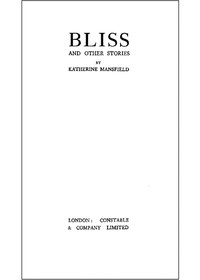
The catalog record for Bliss, and other stories — Reading Companion provides practical reading context through 70,186 words, 5 hr 6 min estimated reading time, and 15 detected text sections.
The text analysis averages about 13.2 words per sentence, while the detected sections provide another way to judge how the source is divided.
Project Gutenberg metadata also associates the work with “Short stories, New Zealand,” connecting these edition facts with the source record’s subject description.
Explore this collection
These alternatives are selected using recorded categories and estimated reading time.
About 305 minutes
Historical Psychological Social Fiction
70,041 recorded words. 1 minutes difference from this book's estimate.
View Gutenberg source #47523About 301 minutes
Historical Psychological Social Fiction
69,130 recorded words. 5 minutes difference from this book's estimate.
View Gutenberg source #43726About 315 minutes
Historical Psychological Social Fiction
72,278 recorded words. 9 minutes difference from this book's estimate.
View Gutenberg source #46621Search stored excerpts and compare books → Choose by your preferences →
Choices use stored catalog measurements. Estimates vary with reading speed. A shared category is a catalog label, not a claim that two books have the same argument or literary quality.
Search reads excerpt text stored with this catalog and links to its associated Gutenberg record. The connection is stored in the site database; this tool does not recheck that every excerpt is word-for-word identical to that external record. Excerpt search does not cover every chapter and does not verify historical publication dates.
Catalog snapshot checked: 2026-09-26. Coverage: 98 public books, 98 available source excerpts.
Calculated from edition completeness, EPUB availability, text structure and catalogue metadata. Not a user rating.
Total of 100 points, scaled to a 2.5-5.0 range. Editions with an empty description or a missing EPUB file are not scored.
Public-domain source text
The source text is kept in the dedicated reader, separate from this catalogue record and its commentary.
The collection begins with a family departure so cramped that Lottie and Kezia must be left behind. Linda Burnell, trembling with fatigue and excitement, laughs strangely as she contemplates casting off her own children like excess luggage. Mansfield renders the scene through sharp, comic particulars: brass anchor buttons, a 'big jelly of a face' leaning across the gate, and Linda's longing to tell the girls to stand on their heads. The voice is precise, ironic, and alert to the gap between what characters say and what they feel.
Across the stories, Mansfield builds interiors—a studio with red chairs, a black table, a sleeping boy's head—that become charged with unspoken meaning. The excerpts show her habit of letting objects and gestures carry emotional weight, while dialogue often circles around what cannot be said directly.
In the opening of 'Prelude,' household goods are piled on the lawn, tables standing on their heads, and Linda Burnell waves a white hand at them as if dismissing her own life. Mansfield repeatedly uses furniture, food, and clothing to index inner states. A cake is described as 'the kind of cake that might have been mentioned in the Book of Genesis'; a teapot lid holds a miniature landscape. These details are not decorative—they are the medium through which characters experience and evade their emotions.
Later, in the studio scene, the male visitor notes that he 'never notice[s] places or furniture' except this one room, which he can recall 'down to every detail.' The red chairs, the bowl of fruit, the sleeping boy's head become talismans of a connection he cannot name. Mansfield's method is to make the physical world so vivid that it speaks for the characters, who often cannot speak for themselves.
Mansfield's dialogue is full of pauses, half-finished sentences, and laughter that does not match the situation. Linda Burnell's 'strange little laugh' as she contemplates abandoning her children sets a pattern: characters laugh when they are uncomfortable, speak fast when they are hiding something, and fall silent when truth threatens to surface.
In the studio excerpt, a 'new silence' descends after the man murmurs 'I love that little boy.' The silence is not peaceful—it is a shift in the air, a recognition that something has changed. Mansfield marks these moments precisely: 'Nothing in the least like the satisfactory pause that had followed their greetings.' The reader learns to watch for these breaks, where the real story leaks through the gaps in conversation.
Mansfield's narrators stay close to a character's perspective but do not endorse it. Linda Burnell's thoughts are rendered with ironic sympathy: she finds the upside-down tables 'absurd' and wishes the children would stand on their heads too. The reader sees both her fatigue and her self-dramatizing humor. Similarly, the woman in the studio scene cuts cake and speaks of 'harvest' and 'real English Comedy' with a confidence that the narrative undercuts by showing her companion's distracted gaze.
The man's confession that he 'simply haven't got any external life at all' is delivered with a 'strange naive way' that makes it hard to read as either sincere or performative. Mansfield does not resolve these ambiguities. She lets voices contradict themselves, and the reader must weigh each statement against the physical details that surround it.
The collection opens with a departure that is also an abandonment, and the excerpts suggest that Mansfield returns to moments of transit—buggies, trains, doorways—as sites of emotional crisis. The man in the studio compares himself to 'a man who wakes up in a train to find that he has arrived, already, at the journey's end.' The simile is apt: Mansfield's characters are often caught between leaving and arriving, never fully present.
In 'Prelude,' the children are handed off to a neighbor; the mother shuts her eyes and leans back. The physical motion of travel—the buggy pulling away, the dray arriving in the evening—mirrors the characters' inner drift. These thresholds, rather than the destinations, are where Mansfield's stories happen. A first reader may watch for how each story begins and ends: not with resolution, but with a suspension that feels like waiting.
Mansfield's stories reward attention to what is not said. The excerpts show a writer who trusts objects, gestures, and silences more than declarations. A first reading might track how each story uses a single physical detail—a cake, a teapot, a sleeping head—to anchor its emotional logic. The collection's range, from New Zealand domestic life to European studios, is unified by this method of indirection. Let the furniture speak, and the characters will follow.
Reading the buggy packed with “absolute necessities,” I remembered watching my grandmother pack for a move she never made—her hands deciding what mattered. That same ache of unspoken choices surfaces in The Relentless City — Inside the Classic, where rooms hold more than people admit. Mansfield’s teapot-lid sky felt familiar, like a breath held too long between old friends.
Build a private reading journal entry for this title.