About 246 minutes
Erchie, My Droll Friend — Reading Notes
Fairy Tales Myths Imaginary Worlds
56,414 recorded words. 2 minutes difference from this book's estimate.
View Gutenberg source #47991
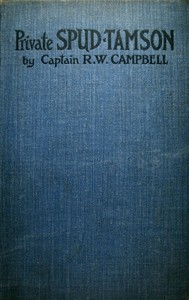
Before opening Private Spud Tamson — A Closer Reading, the edition data offers a quick orientation: 55,994 words, 4 hr 4 min estimated reading time, and 25 detected text sections.
The text analysis averages about 13.1 words per sentence, while the detected sections provide another way to judge how the source is divided.
Project Gutenberg metadata also associates the work with “World War, 1914-1918 -- Fiction,” connecting these edition facts with the source record’s subject description.
Explore this collection
These alternatives are selected using recorded categories and estimated reading time.
About 246 minutes
Fairy Tales Myths Imaginary Worlds
56,414 recorded words. 2 minutes difference from this book's estimate.
View Gutenberg source #47991About 215 minutes
Fairy Tales Myths Imaginary Worlds
49,445 recorded words. 29 minutes difference from this book's estimate.
View Gutenberg source #42905About 215 minutes
Fairy Tales Myths Imaginary Worlds
49,385 recorded words. 29 minutes difference from this book's estimate.
View Gutenberg source #44226Search stored excerpts and compare books → Choose by your preferences →
Choices use stored catalog measurements. Estimates vary with reading speed. A shared category is a catalog label, not a claim that two books have the same argument or literary quality.
Search reads excerpt text stored with this catalog and links to its associated Gutenberg record. The connection is stored in the site database; this tool does not recheck that every excerpt is word-for-word identical to that external record. Excerpt search does not cover every chapter and does not verify historical publication dates.
Catalog snapshot checked: 2026-09-26. Coverage: 98 public books, 98 available source excerpts.
Calculated from edition completeness, EPUB availability, text structure and catalogue metadata. Not a user rating.
Total of 100 points, scaled to a 2.5-5.0 range. Editions with an empty description or a missing EPUB file are not scored.
Public-domain source text
The source text is kept in the dedicated reader, separate from this catalogue record and its commentary.
From its first pages, Private Spud Tamson establishes a voice that is both sardonic and affectionate toward its subject. The narrator describes the Glesca Mileeshy as a 'noble force, recruited from the Weary Willies and Never-works of Glasgow,' immediately signaling a tone that mixes mock-heroic praise with blunt realism. The dialogue, rendered in thick Scots dialect, reveals character through speech: Spud's casual admission that his father 'hisna had a waash since he got mairret' and his ignorance of his own age set him apart from conventional recruits. The author, Captain R. W. Campbell, frames the story as a 'composite study' of Militia types, not a single regiment, allowing for a gallery of exaggerated figures.
The excerpts show how Campbell uses Scots vernacular to define Spud Tamson and his world without explanatory translation. When the recruiting sergeant asks his religion, Spud replies, 'The Salvation Army. Ye see, the auld chap kept in wi' them, for they gie him a bed when he's "on the bash."' The dialect is not merely decorative; it conveys Spud's pragmatic, unsentimental view of institutions. His father's imprisonment is mentioned as a matter of fact—'the year that the auld chap wis sent tae Peterheid'—and the reason given with deadpan humour: 'Knockin' lumps aff the auld wife's heid wi' a poker.' This linguistic choice roots the narrative in a specific social milieu, where poverty, crime, and military service are intertwined. The narrator does not gloss or judge, letting the dialogue carry the weight of character.
Although the book is titled after a private soldier, the narrative voice often reflects an officer's amused, slightly detached observation. The author's dedication to his commanding officer and brother officers hints at this dual perspective. In the sheep-shooting episode, the officers are 'having a little refreshment in the range-keeper's hut' while the men, under Sergeant Maloney, open fire on a flock of prize sheep. The resulting chaos—fifty sheep killed, the sergeant arrested, the colonel's fury—is recounted with a knowing wink. The officers 'gladly paid' the two hundred pounds 'for the honour of the regiment,' and the culprits receive 'hero-worship' in the canteen. This framing allows Campbell to satirise both the men's indiscipline and the officers' willingness to cover up mishaps, all within a tone of good-humoured complicity.
In the later excerpt on artillery formation, the narrator adopts a tone of instructional irony. The 'diamond formation' is described as a 'cunning device of our General Staff; presenting to every man the opportunity of glory and the chance (sometimes meagre) of getting home to one's own fireside.' The language of sport and gambling—'sporting chance,' 'blot out one of the sections'—undercuts the deadly seriousness of the tactics. The soldier is advised to 'get behind a blade of grass or a jam tin' to stop a bullet, and the goal is to 'create as many German widows as they possibly can.' This blend of technical detail and black humour is characteristic of Campbell's approach: he treats the machinery of war as both absurd and practical, never losing sight of the human cost but refusing to dwell on it sentimentally.
Throughout the excerpts, physical needs and appetites punctuate the narrative. The recruiter is 'feeling thirsty and much in need of his half-crown fee'; Spud's last bath was 'last Glesca Fair,' ten months earlier; his father's Salvation Army connection provides a bed when he is 'on the bash' (a drinking spree). The sheep-shooting episode ends with the cost of two hundred pounds, paid by officers who 'gladly paid—for the honour of the regiment,' but the men's canteen celebration is where the story lives. These details ground the comedy in bodily reality: hunger, thirst, dirt, and the constant search for comfort. Even the tactical discussion includes the image of a soldier sheltering behind a jam tin. Campbell uses these motifs to remind readers that war is not all glory; it is also a matter of staying fed, dry, and alive.
Readers should approach Private Spud Tamson as a period piece that reveals attitudes toward military life just before the full horrors of the Western Front became widely known. The humour is often coarse, the dialect dense, and the politics implicit rather than stated. Pay attention to the narrative distance: the author was a serving officer, and his affectionate mockery of the 'Glesca Mileeshy' carries both insider knowledge and a certain class perspective. The book is best enjoyed for its vivid dialogue and set-pieces, not as a realistic war novel.
Reading about Spud Tamson’s chaotic militia days, I remembered my grandfather’s war stories—not the battles, but the sheer absurd boredom between them. That same strange warmth surfaced in Goethe and Schiller: An Historical Romance — Inside the Classic, where great minds fumble through daily pettiness. Both books treat history’s muddle with a fond, wry shrug, like old friends laughing at their own younger selves. It felt familiar, somehow—that gentle reconciliation with the past’s foolishness.
Use these questions to collect your thoughts before moving on.