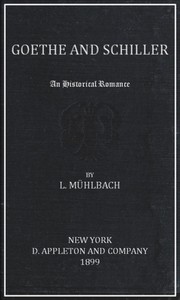
Goethe and Schiller: An Historical Romance — Inside the Classic
Edition facts
Goethe and Schiller: An Historical Romance — Inside the Classic can be approached with a clearer sense of reading commitment from its source measurements: 182,329 words, 13 hr 13 min estimated reading time, and 18 detected text sections.
The text analysis averages about 18.7 words per sentence, while the detected sections provide another way to judge how the source is divided.
Project Gutenberg metadata also associates the work with “Goethe, Johann Wolfgang von, 1749-1832 -- Fiction,” connecting these edition facts with the source record’s subject description.
Calculated from edition completeness, EPUB availability, text structure and catalogue metadata. Not a user rating.
How this score is calculated
- Description quality20 pts
- Title & short description10 pts
- Source metadata20 pts
- Text length15 pts
- Chapters / structure15 pts
- EPUB file integrity20 pts
Total of 100 points, scaled to a 2.5-5.0 range. Editions with an empty description or a missing EPUB file are not scored.
Read the Text
The honest and peaceful inhabitants of Mannheim, the capital of the Palatinate, had long since retired to rest; the streets were deserted, and the houses wrapped in darkness. Only high up in the little bow window of a corner house on the Palace Square still glimmered a faint light like the subdued gleam of a lamp in a sick-chamber.
But the watch, who had just proclaimed at the corner in stentorian tones the third hour of the morning, knew better; and, as he entered the square, he again looked up at the illuminated window, gravely shaking his head.
"Mr. Schiller has not yet gone to bed," said he to himself; "writing all night again, I suppose. But I will not stand it! Did I not promise Mr. Streicher that I would always look up at his window, and, whenever I found the light burning after one o'clock, protest against it? Well, then, I'll try it to-night, and keep my word, as an honest man should."
And in stentorian tones the watchman cried out, "Mr. Schiller! Halloo! Mr. Schiller!"
For a moment the window was darkened by a shadow, and then opened, and a hoarse voice demanded, "Who called? who called my name?"
"I, Mr. Schiller. I, the watchman, Fabian," roared the man in response.
"And what do you desire of me, worthy guardian of the worthy city of Mannheim?"
"I wish to beg of you, Mr. Schiller, to be so good as to put out your light and go to bed."
"What brought you to this strange and ridiculous idea?" exclaimed the voice from above, laughing loudly. "What does the light behind my windows concern you, a watchman and a guardian of the streets?"
"Really it doesn't concern me at all," cried the watchman. "I know that very well, but I have promised the music-teacher of my daughter, Mr. Streicher, to pay attention to your window, and every time I see the light burning in your room after one o'clock, to call you, and beg you in the name of your dear friend to be kind enough to put out your light and go to bed."
"A very ridiculous idea of Mr. Streicher," said the voice of the invisible poet, laughingly, "and I am only surprised that you should do his bidding, and take this task upon yourself."
"Don't be surprised, sir, for I am not doing it gratis. Mr. Streicher told me that whenever I had called you, and begged you in his name to go to bed, I should have to pay only half-price for the next piano-lesson of my daughter; and I beg you, therefore, Mr. Schiller, to be good enough to tell Mr. Streicher to-morrow that I have done his bidding. And hereafter do as you please, sleep or wake. I have done my duty. Good-night, Mr. Schiller."
The poet rapidly closed the window, and drew the folds of the old threadbare coat which served him as a dressing-gown closer around his shivering form.
"The good and true Streicher," he murmured in a low voice, "is an honest soul, and means well, and does not know how he has injured me to-day! I was in the grandest flow of enthusiasm; all the discomforts and necessities of life had disappeared! I was no longer cold, there were no more tormenting creditors, no cares, and no pangs of love! I was in thy heaven, Father Zeus! And the messenger of my friend comes and calls me back to the cold, inhospitable earth. The fire of my enthusiasm is extinguished, and now I am sensible that there is no fire in the stove!"
He raised his large blue eyes, and glanced through the dimly-lighted space toward the high black stove, within the open grate of which only a few glimmering coals were visible.
"No fire," sighed Schiller, shrugging his shoulders, "and no wood to make one. Poor, feeble man! The fire of the soul does not suffice to warm thy shivering body, and the prose of life ever recalls thee from the Elysian fields of poetry. But it shall have no power over me. I will defy it! Forgive me, friend Streicher, but I cannot do your bidding! Your watchman calls to me to sleep, but Don Carlos calls to me to be wakeful! I cannot let the Spanish prince call in vain! Fortunately the coffee-pot is still standing in the stove. If it is yet warm, something can be done for the poor, shivering body."
He rapidly went across the room to the stove, knelt down before the fire-place, drew the brown coffee-pot from its bed of ashes, raised it to his lips and refreshed himself with several long draughts, after which he carefully restored the vessel to its former place.
The novel opens not with the poets themselves but with a watchman shaking his head at a light burning in Schiller's attic window past three in the morning. This small act of surveillance—a promise made to a friend, Streicher—immediately frames Schiller as a figure watched over, his nocturnal labor both admired and regulated by the civic order below. The watchman's protest, "I will not stand it!" introduces a tension between creative compulsion and external expectation that runs through the excerpts.
Later, in a very different interior, Madame von Arnim places a lamp in a conspicuous window not to aid a writer but to signal his absence, ensuring that the poet Schiller stays away from her daughter Marie. The same prop—a light in a window—carries opposite meanings: for Schiller, a beacon of work; for the Arnim household, a warning to keep him out. This contrast in the use of domestic space and light offers a precise entry into the novel's social and emotional landscape.
The Watchman's Gaze and the Poet's Window
The opening chapter establishes a distinctive point of view: the watchman who observes Schiller's light and feels entitled to call up to him. "Mr. Schiller! Halloo! Mr. Schiller!"—the direct address from the street to the window collapses the distance between public order and private genius. The watchman's self-description as "an honest man" keeping his word to Streicher suggests that Schiller's creative life is embedded in a network of small obligations and watchful relationships.
This is not a solitary genius myth. The watchman knows Schiller's habits, judges them, and acts on a promise. The light in the window is a signal legible to the whole square. When the window opens and a "hoarse voice" responds, the reader hears the poet only as an interruption, a shadow. The scene establishes that Schiller's work is visible, audible, and subject to commentary from below. The novel's attention to such minor characters—the watchman, the friend Streicher, the mother Madame von Arnim—suggests that the poets' stories are told through the people who watch, wait, and intervene.
A Mother's Stagecraft and the Erased Poet
In Book III, Madame von Arnim orchestrates an evening party with the precision of a director. She places a light in the window to keep Schiller away, then "repaired to the parlor to receive her guests" with a "stereotyped smile" and "polite phrases." The narrator notes her skill in disposing of old ladies into the boudoir and recruiting an invalid major for whist—"rendered their gossiping tongues harmless." The language is clinical, almost theatrical: the young women invited are described as "the setting which gives additional lustre to the gem."
Marie von Arnim, the gem, is described as "radiant" and "joyous" after tears have "flowed back to her heart." The count, Ehrhard von Kunheim, watches her with a proprietary gaze, imagining his triumph in claiming her as bride. Schiller is discussed as an absent curiosity—"Is he likely to come this evening?"—and his absence is enforced by the mother's signal. The poet is reduced to a topic of conversation, a name praised by officers who have never met him. The scene dramatizes how social power erases the poet's presence while consuming his reputation.
Contrasting Lights: Work, Warning, and Performance
The excerpts repeatedly use light as a marker of intention and power. Schiller's light is a sign of labor, visible to the watchman and the reader. Madame von Arnim's light is a deliberate signal to keep Schiller away—"the light must be burning—Schiller must be kept away." When Marie mechanically repeats "No, he is not coming," the light has already done its work. The same object, a lamp in a window, signifies opposite things: for the poet, presence and production; for the mother, absence and exclusion.
This pattern extends to the characters' visibility. Schiller is heard but barely seen—a shadow, a hoarse voice. Marie is seen but her tears are hidden, her smile performed. The count sees only the surface: "her countenance was rosy and joyous." The novel's structure of observation—who sees whom, and what they choose to reveal or conceal—creates a world where poets are managed by patrons, daughters are managed by mothers, and every light in a window carries a message. The reader is invited to notice who controls the light and who is left in the dark.
The excerpts offer a view of Schiller and Goethe's world not through their own words but through the people who surround them: a watchman, a mother, a suitor. The novel's attention to the mechanics of social performance—the placement of a lamp, the arrangement of guests, the management of reputations—suggests that the poets' lives are shaped by forces they cannot fully control. Readers attentive to these small signals will find a story told in gestures and objects as much as in dialogue and declaration.
I remember Mühlbach’s watchman, muttering against poetry’s lofty demands, while Schiller weighed his genius against a prince’s coin. Such private bargaining feels familiar. It reminded me of another quiet soul, scribbling in margins, deciding which secret deserved daylight. The Mystery Girl — Reading Notes holds similar hush—the price of a life half-told, kept not for glory, but for breath.

There are no reviews for this eBook.
Before you leave, reflect on the book
Use these questions to collect your thoughts before moving on.