About 711 minutes
Samuel Boyd of Catchpole Square: A Mystery — Edition Insights
Historical Psychological Social Fiction
163,367 recorded words. 98 minutes difference from this book's estimate.
View Gutenberg source #43198
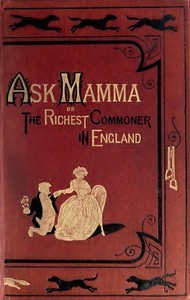
"Ask Mamma"; or, The Richest Commoner In England — Edition Insights can be approached with a clearer sense of reading commitment from its source measurements: 185,983 words, 13 hr 29 min estimated reading time, and 23 detected text sections.
The text analysis averages about 24.1 words per sentence, while the detected sections provide another way to judge how the source is divided.
Project Gutenberg metadata also associates the work with “England -- Social life and customs -- 19th century -- Fiction,” connecting these edition facts with the source record’s subject description.
Explore this collection
These alternatives are selected using recorded categories and estimated reading time.
About 711 minutes
Historical Psychological Social Fiction
163,367 recorded words. 98 minutes difference from this book's estimate.
View Gutenberg source #43198About 655 minutes
Historical Psychological Social Fiction
150,587 recorded words. 154 minutes difference from this book's estimate.
View Gutenberg source #46443About 646 minutes
Historical Psychological Social Fiction
148,538 recorded words. 163 minutes difference from this book's estimate.
View Gutenberg source #44210Search stored excerpts and compare books → Choose by your preferences →
Choices use stored catalog measurements. Estimates vary with reading speed. A shared category is a catalog label, not a claim that two books have the same argument or literary quality.
Search reads excerpt text stored with this catalog and links to its associated Gutenberg record. The connection is stored in the site database; this tool does not recheck that every excerpt is word-for-word identical to that external record. Excerpt search does not cover every chapter and does not verify historical publication dates.
Catalog snapshot checked: 2026-09-26. Coverage: 98 public books, 98 available source excerpts.
Calculated from edition completeness, EPUB availability, text structure and catalogue metadata. Not a user rating.
Total of 100 points, scaled to a 2.5-5.0 range. Editions with an empty description or a missing EPUB file are not scored.
Public-domain source text
The source text is kept in the dedicated reader, separate from this catalogue record and its commentary.
From its opening pages, Ask Mamma establishes a world where social performance and sporting bravado are inseparable. The character of Cuddy Flintoff, an “all about” sportsman who lives on past glories, punctuates his conversation with hunting cries like “yoicks wind ‘im!” and “for-rards on!”, so that a listener would think he was “hunting a pack of hounds.” This theatricality extends to his dress: bird’s-eye cravats, step-collared striped vests, and Oxford-grey cutaways, all worn by a man who “scarcely ever” rides. Surtees uses such figures to satirize the gap between appearance and reality in the hunting field.
The novel’s title, a refrain that recurs throughout, points to the hero Billy Pringle’s habit of deferring to his mother on matters of finance and matrimony. The excerpts show him as a passive observer, “listening to their dreadful recitals” and wishing himself “back at the peaceful pursuits of Yammerton Grange.” His wealth—he is “the richest commoner in England”—makes him a target for schemers like Sir Moses Mainchance, who promises to “show him sport” while maneuvering for advantage.
The hunting world in Ask Mamma is a stage, and its characters are performers. Cuddy Flintoff’s constant use of hunting cries in ordinary conversation—helping himself along with “for-rardson! for-rards on!”—turns walking into a parody of a chase. When the dressing-bell rings, he “suddenly turned whipper-in,” shrieking “hoick halloa!” and driving the company before him. This blending of hunting language with domestic routine suggests that for some, the sport is less about actual riding than about the verbal and gestural repertoire that signals belonging.
Sir Moses Mainchance, the host, reinforces this theatricality. He describes Cuddy as a “rum fellow” and “cleverest fellow under the sun,” yet the reader sees Cuddy’s act as hollow. The guests at Sir Moses’s dinner compete in praising their country’s hazards—bottomless brooks, enormous bullfinches, terrific stone walls—each trying to outdo the other. Their unanimous boast that “the man who could ride over Hit-im and Hold-im-shire could ride over any country in the world” is undercut by Billy’s silent wish to escape. Surtees thus uses dialogue to expose the gap between self-promotion and reality.
Surtees builds character through precise material details. When Sir Moses shows Billy to his room, the narrator notes that it is “wretchedly furnished” and “wanted all the little neatnesses and knic-knaceries peculiar to a lady-kept house.” The towels are “few and flimsy,” the soap “hard and dry.” This inventory of domestic shortcomings quietly signals Sir Moses’s bachelor status and his lack of genuine hospitality, despite his grand promises.
Similarly, Cuddy Flintoff’s costume is itemized: “bird’s-eye cravats, step-collared striped vests, green or Oxford-grey cutaways, with the neatest fitting trousers on the best bow-legs that ever were seen.” The accumulation of clothing details—down to his “cheesy hat well down on his nose” and “stout, well-cleaned doe-skin gloves”—creates a portrait of a man who dresses the part of a sportsman obsessively, even though his sporting is “in the past tense.” These objects become shorthand for character, revealing aspirations and limitations without direct commentary.
Billy Pringle, the titular “richest commoner,” is defined by his passivity and his reliance on his mother’s judgment. The novel’s title, Ask Mamma, encapsulates his habitual deference. In the excerpt, he sits “listening to their dreadful recitals” and “thought that he had got into the lion’s den with a vengeance.” His internal wish to return to “the peaceful pursuits of Yammerton Grange” contrasts sharply with the aggressive boasting around him.
Billy’s wealth makes him a target, but his naivety prevents him from recognizing manipulation. When Sir Moses asks “how he left the Major, how he found his way there, with hopes that everything was comfortable,” Billy seems unaware of the calculating tone behind the pleasantries. The narrative voice, however, undercuts Sir Moses’s promises with the parenthetical “oh! agonising promise!”—a signal to the reader that Billy is being set up. This gap between Billy’s perception and the reader’s understanding drives much of the novel’s comedy and tension.
Readers approaching Ask Mamma should attend to the way Surtees uses dialogue, costume, and setting to create a satirical portrait of hunting society. The novel rewards attention to small details—a flimsy towel, a misplaced hunting cry—that reveal character and social dynamics. Billy Pringle’s passivity invites both sympathy and exasperation, and his journey through a world of bluff and bluster offers a wry commentary on the gap between wealth and wisdom.
There’s something tender about Billy Pringle’s muddled efforts to buy approval, each scheme a small, hopeful fumble. It left me thinking of another quiet struggle, one where the ache runs deeper beneath the surface of polite society. The memory of that story lingers like a half-remembered tune, and I found myself returning to The Angel of Pain — Inside the Classic for its softer, more sorrowful echoes.
Save your reaction, strongest insight, and memorable passage.