
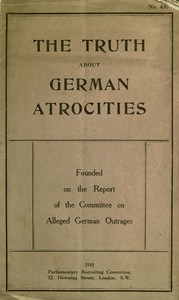
The Truth About German Atrocities by Anonymous
Let's be clear from the start: this is a tough read. 'The Truth About German Atrocities' isn't a novel with a plot. Published in 1915 by an anonymous author or committee, it's a compiled document. Its purpose was stark and immediate: to present evidence of war crimes committed by German forces in the early months of World War I, particularly during the invasion of Belgium and France.
The Story
The book is structured as a series of sworn statements, diary entries from civilians and soldiers, excerpts from official inquiries (like the Bryce Report), and firsthand testimonies. It details specific incidents—the destruction of towns like Louvain, the killing of civilians, and allegations of systematic brutality. There's no narrative arc in the traditional sense. Instead, the 'story' is the cumulative weight of these accounts, page after page, building a case meant to shock and mobilize Allied and neutral public opinion against Germany. It's history as a weapon, served raw.
Why You Should Read It
I found this book fascinating not as a final verdict on historical truth, but as a time capsule of anger and persuasion. You're reading propaganda in its original, urgent form. It makes you ask hard questions: How do we verify trauma in the middle of a war? What's the line between documenting truth and crafting a narrative for victory? The anonymity adds another layer—was this an act of protection, or did it lend the work an air of collective, undeniable authority? Reading it today, with our knowledge of later 20th-century atrocities, it also becomes a chilling early chapter in the history of documenting human rights abuses. It's less about the specific details (which historians continue to debate) and more about feeling the desperate pulse of 1915, a moment when someone believed compiling these stories was the most important thing they could do.
Final Verdict
This book isn't for everyone. It's graphic, one-sided by design, and emotionally draining. But it's perfect for readers interested in the raw mechanics of wartime propaganda, the history of human rights reporting, or WWI beyond the trenches. If you approach it not as a definitive textbook, but as a primary source that screams from the past, it's incredibly illuminating. Think of it as a partner read to more balanced modern histories—a vital, uncomfortable piece of the puzzle that shows how war is fought on the page as well as the battlefield.
This is a copyright-free edition. You do not need permission to reproduce this work.
Susan Martin
8 months agoThis is an essential addition to any academic digital library.
Donald Davis
11 months agoLooking at the bibliography alone, the inclusion of diverse viewpoints strengthens the overall narrative. The insights gained here are worth every minute of reading.
Elizabeth Rodriguez
1 year agoThe author provides a very nuanced critique of current methodologies.
Susan Lopez
3 months agoIf you're tired of surface-level information, the footnotes provide extra depth for those who want to dig deeper. I'll be citing this in my upcoming project.
David Gonzalez
1 month agoExactly what I was looking for, thanks!