
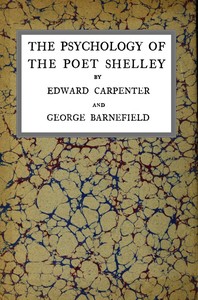
The psychology of the poet Shelley by Edward Carpenter and Guy Christian Barnard
Forget the dusty portrait of a dreamy poet. 'The Psychology of the Poet Shelley' grabs you by the collar and asks: what was really going on in that man's mind? Written in the 1920s by Edward Carpenter and Guy Christian Barnard, this book isn't your standard life story. Instead, it uses the psychological ideas of its day—think Freud and Jung making early waves—to dissect Shelley's inner world.
The Story
There's no traditional plot here. The 'story' is the unfolding of a personality. The authors walk us through Shelley's life—his rebellious youth, his radical beliefs, his intense relationships, and his brilliant poetry—but they're not just listing events. They're treating each moment as evidence. They look at his fraught relationship with his father, his quest for an ideal love that never seemed to work out in reality, and his powerful identification with outcasts and rebels. The book connects these life experiences directly to the themes in his work: the desire to tear down old systems, the worship of nature as a spiritual force, and the profound loneliness that often shadows his most soaring verses. It builds a psychological profile, arguing that his poetry was a direct outlet for his inner conflicts and desires.
Why You Should Read It
What's so cool about this book is its boldness. Reading it today, some of its 1920s psychology feels dated, but that's almost part of the fun. It's a time capsule of how people once tried to understand genius. More importantly, it forces you to see Shelley as a complex, troubled, and driven human being, not just a marble statue of 'The Poet.' It makes his work feel more urgent and personal. When you read about his psychological need for rebellion and then revisit a poem like 'The Mask of Anarchy,' it hits differently. The book reminds us that great art doesn't come from a place of calm, perfect happiness, but often from a mind wrestling with its own demons and ideals.
Final Verdict
This one is perfect for Shelley fans who think they know everything about him, or for anyone interested in the messy intersection of art, life, and the mind. It's also a great pick for readers who enjoy literary history and seeing how different eras try to solve the puzzles of the past. If you want a straight, modern biography, look elsewhere. But if you're up for a thought-provoking, slightly old-fashioned, and deeply curious psychological deep-dive into one of literature's most fascinating figures, this hidden gem is absolutely worth your time. Just be ready to argue with the authors—that's half the point.
This content is free to share and distribute. Enjoy reading and sharing without restrictions.
Thomas Thompson
1 year agoClear, concise, and incredibly informative.
Margaret Martin
2 years agoIt’s rare to find such a well-structured narrative nowadays, the clarity of the writing makes even the most dense sections readable. Simple, effective, and authoritative – what else could you ask for?
Sarah Brown
3 weeks agoBefore I started my latest project, I read this and the author clearly has a deep mastery of the subject matter. I’ll definitely be revisiting some of these chapters again soon.
Melissa Ramirez
2 years agoJust what I was looking for.



Jessica Wilson
9 months agoIf you're tired of surface-level information, the nuanced approach to the central theme was better than I expected. This is a solid reference for both beginners and experts.