
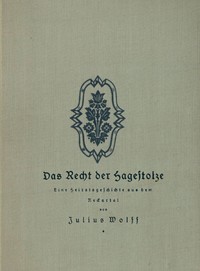
Das Recht der Hagestolze: Eine Heiratsgeschichte aus dem Neckartal by Julius Wolff
Julius Wolff's Das Recht der Hagestolze is a real treat. It’s not a stuffy period piece; it feels like stepping into a lively village where gossip travels fast and everyone knows everyone else's business.
The Story
The story revolves around two older farmers, Veit and Kilian. They’ve been friends since childhood, but their shared vow to remain bachelors—proud Hagestolze—has slowly turned them into rivals. They compete over everything: who has the better farm, the finer wine, the most unshakeable commitment to single life. Their quiet valley is their whole world. Then, Lene arrives. She’s a bright, capable young woman who comes to care for a relative. With her warmth and good sense, she quickly becomes beloved in the village. Without even trying, she throws the two men's carefully balanced feud into chaos. Watching these two stubborn old men stumble through their sudden confusion—and their even more sudden jealousy—is both laugh-out-loud funny and genuinely touching.
Why You Should Read It
What I loved most is that Wolff doesn’t make fun of his older characters. He treats them with real affection. Veit and Kilian aren't caricatures; they're set in their ways, proud, and a little ridiculous, but you understand why. Their friendship-turned-rivalry feels very real. Lene is the perfect catalyst—she’s no passive heroine. She’s observant, kind, and has a quiet strength that commands respect. The book is really about how life has a way of changing your plans. It asks: what happens when the identity you’ve built for decades—the ‘confirmed bachelor’—starts to feel less like a choice and more like a cage? The setting is gorgeous, the humor is gentle, and the heart of the story sneaks up on you.
Final Verdict
This is a perfect read for anyone who enjoys character-driven stories with a lot of heart and humor. If you like novels about small-town dynamics, second chances later in life, or stories that prove it’s never too late to change, you’ll adore this. It’s also a fantastic pick for readers curious about 19th-century German regional life, but who want something much cozier and more personal than a heavy historical epic. Think of it as a warm, witty conversation with a clever friend about the funny things people do for love and pride.
Legal analysis indicates this work is in the public domain. You can copy, modify, and distribute it freely.
Emma Thomas
1 year agoI was skeptical at first, but the arguments are well-supported by credible references. Definitely a 5-star read.
Daniel Smith
1 year agoI started reading out of curiosity and the character development leaves a lasting impact. A valuable addition to my collection.



Ava Allen
2 years agoAs someone who reads a lot, it creates a vivid world that you simply do not want to leave. I learned so much from this.