
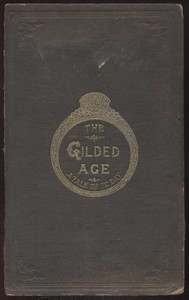
The Gilded Age, Part 5. by Mark Twain and Charles Dudley Warner
Alright, let's dive into the grand finale of Twain and Warner's wild ride through post-Civil War America. This isn't a straightforward novel with a single hero; it's a bustling portrait of a nation figuring out what it wants to be.
The Story
We're in Washington D.C., a city buzzing with more ambition than sense. The story weaves together the fates of several characters. There's Colonel Beriah Sellers, the eternal optimist with a new money-making scheme every week. Then we have the more earnest (and often poorer) Hawkins family, along with a young engineer named Philip Sterling and his friend Henry Brierly, who are chasing their own fortunes. Part 5 brings their journeys to a head. It's all about the scramble for a massive government appropriation to build a railroad. Lobbyists swarm, votes are traded, newspapers are bribed, and fortunes are promised on paper long before a single rail is laid. The plot asks a simple, brutal question: in a world where influence is the real currency, can integrity survive, or does it just get left at the station?
Why You Should Read It
First, it's funny. Twain's fingerprints are all over the satire, especially in the character of Colonel Sellers, whose boundless confidence in doomed ventures is both tragic and hysterical. But the real punch is how current it feels. Reading about the circus of lobbying, the empty political promises, and the public's fascination with shady financial bubbles is like reading today's headlines, just with fancier hats. The authors don't just point fingers; they show how regular people get swept up in the frenzy, hoping to grab their piece of the pie. It’s a story about American hunger—for wealth, for status, for a new beginning—and the moral corners we cut to satisfy it.
Final Verdict
This is a perfect pick for anyone who loves historical fiction that doesn't feel like homework. It's especially great if you enjoy political satires like Veep or stories about hustlers and dreamers. You don't need to be a history expert; you just need a little curiosity about how the wheels of power and money have always turned. Fair warning: the large cast and meandering plot can take some getting used to, but stick with it. The payoff is a brilliantly cynical, deeply human, and oddly comforting look at a period that shaped modern America. Turns out, some things never change.
This publication is available for unrestricted use. Use this text in your own projects freely.
Kenneth Jones
1 year agoBased on the summary, I decided to read it and the character development leaves a lasting impact. Don't hesitate to start reading.
Kevin Ramirez
1 year agoText is crisp, making it easy to focus.
Christopher Walker
4 months agoHonestly, the arguments are well-supported by credible references. Worth every second.
David Smith
7 months agoWow.




Paul Jackson
6 months agoAfter spending a few days with this digital edition, the cross-referencing of different chapters makes it a great study tool. I'll be citing this in my upcoming project.