About 294 minutes
The Mystery Girl — Reading Notes
Fairy Tales Myths Imaginary Worlds
67,615 recorded words. 1 minutes difference from this book's estimate.
View Gutenberg source #44984
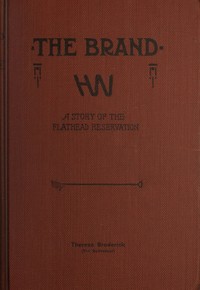
This digital edition of The Brand: A Tale of the Flathead Reservation — A Closer Reading is described by source-level measurements including 67,664 words, 4 hr 55 min estimated reading time, and 35 detected text sections.
The text analysis averages about 18.1 words per sentence, while the detected sections provide another way to judge how the source is divided.
Project Gutenberg metadata also associates the work with “Salish Indians -- Fiction,” connecting these edition facts with the source record’s subject description.
Explore this collection
These alternatives are selected using recorded categories and estimated reading time.
About 294 minutes
Fairy Tales Myths Imaginary Worlds
67,615 recorded words. 1 minutes difference from this book's estimate.
View Gutenberg source #44984About 305 minutes
Fairy Tales Myths Imaginary Worlds
70,023 recorded words. 10 minutes difference from this book's estimate.
View Gutenberg source #43135About 284 minutes
Fairy Tales Myths Imaginary Worlds
65,115 recorded words. 11 minutes difference from this book's estimate.
View Gutenberg source #46610Search stored excerpts and compare books → Choose by your preferences →
Choices use stored catalog measurements. Estimates vary with reading speed. A shared category is a catalog label, not a claim that two books have the same argument or literary quality.
Search reads excerpt text stored with this catalog and links to its associated Gutenberg record. The connection is stored in the site database; this tool does not recheck that every excerpt is word-for-word identical to that external record. Excerpt search does not cover every chapter and does not verify historical publication dates.
Catalog snapshot checked: 2026-09-26. Coverage: 98 public books, 98 available source excerpts.
Calculated from edition completeness, EPUB availability, text structure and catalogue metadata. Not a user rating.
Total of 100 points, scaled to a 2.5-5.0 range. Editions with an empty description or a missing EPUB file are not scored.
Public-domain source text
The source text is kept in the dedicated reader, separate from this catalogue record and its commentary.
The Brand opens with Bess Fletcher on a westbound train, impatient for a glimpse of mountains—a detail that signals the novel’s investment in landscape as emotional backdrop. The first chapter introduces Henry West, a rancher who carries a gun but has used it only once, to shoot a rattlesnake whose rattles he wears on his hatband. This small, specific object recurs as a token of restraint and past violence. The narrative voice, through dialogue and gesture, builds tension around West’s unspoken trouble: he tells his friend James that his problem is ‘something which even God could not help,’ part past, part still to come. The excerpts offer no resolution, only the promise of inevitable confrontation.
The Library of Congress catalog assigns The Brand to ‘Fairy Tales, Myths & Imaginary Worlds,’ yet the excerpts contain no supernatural or folkloric elements. The story is grounded in realistic Western settings: a train, a ranch, a shooting exhibition, a conversation about a gun. The catalog also lists ‘Salish Indians — Fiction’ and ‘Flathead Indian Reservation (Mont.) — Fiction,’ but the available passages show no Salish characters or cultural detail. Instead, the reservation appears as a backdrop for white settlers’ dramas—Bess, Henry, James, and the Indian Agent Dave Davis. The only mention of Indigenous presence is oblique: West’s mother, a chapter titled ‘I Would Have Done More for an Injun,’ and a later chapter ‘I—am—but—an—Indian.’ The excerpts do not reveal whether the novel engages substantively with Salish life or uses the reservation as a setting for a romance plot. Readers should approach the catalog tags with caution.
Broderick invests ordinary objects with narrative weight. The rattlesnake rattles on West’s hatband are described with precision—‘eleven and the button’—and become a shorthand for his history and restraint. The gun itself is handled with care: West ‘thrust it back into its leathern receptacle, giving the holster a firm pat, as if to assure himself the gun was secure—and ready.’ That gesture, observed by Bess, implies a man accustomed to danger. Later, a beaded belt appears in a chapter title (‘The Strength of a Beaded Belt’), suggesting another object that will carry symbolic or plot significance. These details ground the story in material culture rather than abstract themes.
The excerpted dialogue does more to conceal than to reveal. Henry West tells James, ‘My trouble is something which even God could not help. Part of it is past, part is still to come.’ The syntax is deliberate, the confession withheld. James, for his part, offers physical reassurance—‘a friendly arm,’ ‘a gentle pat or two’—but receives no explanation. The conversation with Indian Agent Davis is similarly oblique: Davis asks James’s consent to court his sister, and West overhears but does not intervene. The narrative withholds interiority, letting gesture and silence carry the emotional load. This technique creates a sense of buried conflict that the reader must infer from what is not said.
The excerpts from The Brand offer a narrow window into a novel that may be more concerned with white settlers’ moral crises than with the Indigenous world its catalog suggests. Readers will find a story built on withheld information, significant objects, and landscape as emotional correlative. The title’s ‘brand’—whether literal or figurative—remains unexplained in the available text, a mystery that propels the narrative forward.
Sometimes a story lingers not for its plot but for its quiet moral weight, like Bess’s uneasy choices on the Flathead Reservation. That same hushed tension—between duty and longing—seems to haunt the pages of The Riddle of the Purple Emperor — Themes and Context, though I suppose I’m just remembering how certain old books hold us gently. A familiar ache, really.
Use these questions to collect your thoughts before moving on.