
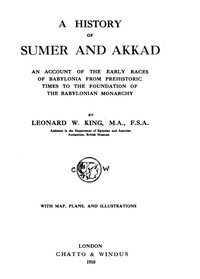
A History of Sumer and Akkad by L. W. King
Forget everything you think you know about 'ancient history.' A History of Sumer and Akkad by L.W. King takes you to the very beginning of the story. This isn't about pyramids or philosophers; it's about the people who invented the idea of a city. King, writing over a century ago, acts as your guide through the archaeological digs and translated cuneiform tablets that brought this lost world back to light.
The Story
There's no single plot, but there is a grand narrative: the rise of human society. King starts with the shadowy early settlers in Mesopotamia and follows the incredible transformation from small villages to powerful city-states like Ur, Uruk, and Lagash. He shows you the Sumerians developing writing to keep track of grain, which then blossomed into literature like the Epic of Gilgamesh. You see the rise of the first empires under Sargon of Akkad, who united the region. The 'story' is built from the ground up—laws like the Code of Ur-Nammu, temple economies, epic poetry, and constant wars for water and power. It ends with the fading of this world, setting the stage for Babylon and Assyria to take over.
Why You Should Read It
What grabbed me was the sheer humanity of it all. King presents these figures not as dusty names but as people with familiar problems: building infrastructure, negotiating treaties, and seeking glory. Reading about Gudea of Lagash commissioning statues or the detailed administrative records makes these ancients feel startlingly real and organized. The most powerful sections explore their inner world—their fears of divine wrath, their quest for immortality in story, and their foundational myths that we still reference today. It connects dots you didn't know were there, showing how concepts like kingship, law, and even the sixty-minute hour were formulated in this fertile crescent.
Final Verdict
This is a classic for a reason, but it's not a light read. It's perfect for history buffs who want to start at the absolute beginning, for fans of archaeology who love seeing a puzzle come together, or for anyone who has ever read Gilgamesh and wanted the full context. Be warned: King's early 20th-century perspective shows, and some information is outdated due to new discoveries. Think of it less as a modern textbook and more as a passionate, foundational tour led by one of the pioneers who helped map this forgotten landscape. If you want to understand where urban life and recorded history truly began, this is your essential starting point.
Legal analysis indicates this work is in the public domain. It serves as a testament to our shared literary heritage.
Sarah Williams
9 months agoThis digital copy caught my eye due to its reputation, the bibliography and references suggest a high level of research and authority. It’s hard to find this much value in a single source these days.
Linda Anderson
1 month agoVery satisfied with the depth of this material.
Robert Miller
2 months agoImpressive quality for a digital edition.
Charles Thomas
9 months agoI stumbled upon this title during my weekend research and the way the author breaks down the core concepts is remarkably clear. This is a solid reference for both beginners and experts.









Matthew Garcia
5 months agoI decided to give this a try based on a colleague's recommendation, the argument presented in the middle section is particularly compelling. I feel much more confident in my knowledge after finishing this.