
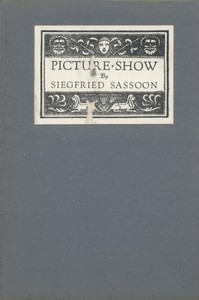
Picture-Show by Siegfried Sassoon
Most of us know World War I from black-and-white photos and dry dates in history class. Siegfried Sassoon's Picture-Show rips that distance away. Published after the war, this collection of poems acts like a series of stark, developed photographs from the front. Sassoon doesn't just describe scenes; he makes you feel the weight of the mud, the jarring silence after a shell blast, and the deep, unsettling confusion of the soldiers.
The Story
There isn't a single narrative, but a progression of moments. The 'story' is the journey of a generation. It starts with glimpses of pre-war England—peaceful, almost naive. Then, we're abruptly in the trenches. Poems like 'The Rear-Guard' plunge you into claustrophobic tunnels with a lost soldier. Others, such as 'Suicide in the Trenches,' expose the psychological collapse the war caused. The collection doesn't build to a battle; it builds to a realization. The real enemy isn't always across No Man's Land—sometimes it's the crushing disillusionment and the struggle to find meaning in the chaos.
Why You Should Read It
I keep coming back to Sassoon's honesty. He's angry, he's grieving, and he's not afraid to point fingers at the generals and politicians he felt betrayed his men. But there's also a deep tenderness for his fellow soldiers. His poems memorialize them not as heroes in a grand statue, but as real, scared, funny, broken boys. Reading this, you don't get a history lesson; you get a human reaction. It makes the war personal. That's why it sticks with you. It’s the difference between knowing the number of casualties and feeling the loss of one person.
Final Verdict
Perfect for anyone who thinks poetry isn't for them. This is direct, powerful, and free of fancy decoration. It's also a must-read for history buffs who want to move beyond facts and figures into the emotional truth of the Great War. If you enjoyed the visceral feel of novels like All Quiet on the Western Front or the poignant clarity of a documentary, you'll connect with this. Be warned: it's not a light read. But it's a short, sharp, and unforgettable one that shows how art can grapple with the worst of our world.
This digital edition is based on a public domain text. You are welcome to share this with anyone.
Donald Martin
5 months agoI've gone through the entire material twice now, and the footnotes provide extra depth for those who want to dig deeper. It cleared up a lot of the confusion I had previously.
Kimberly Lee
2 years agoThe analytical framework presented is both innovative and robust.
Matthew Thompson
1 year agoOne of the most comprehensive guides I've read this year.
Jennifer Taylor
5 months agoThis was exactly the kind of deep dive I was searching for, the concise summaries at the end of each section are a lifesaver. Highly recommended for those seeking credible information.



Margaret Miller
10 months agoThe digital index is well-organized, making research much faster.