
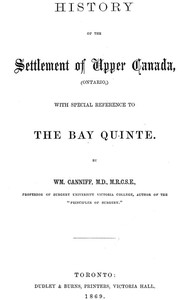
History of the settlement of Upper Canada (Ontario,) by William Canniff
So, what's this book actually about? It's not a novel with a single plot. Instead, imagine a grandparent sitting you down and telling you the family story, but for an entire province. William Canniff's 'History of the Settlement of Upper Canada' is a massive, detailed record of how Ontario went from a vast, sparsely populated wilderness to a network of towns and farms. He starts with the very first European explorers and traders, but the heart of the book is the late 1700s and early 1800s, when waves of settlers—especially United Empire Loyalists—flooded in. He tracks their journeys, their struggles to claim land, and the sheer, back-breaking work of creating a home.
The Story
Canniff structures it like a guided tour through time. He describes the landscape as the first settlers saw it: endless forests, powerful rivers, and the daunting task ahead. He then walks you through the years, settlement by settlement. You'll read about the founding of places like Kingston, York (which became Toronto), and Niagara. He covers the politics, the wars (like the War of 1812), and the growth of government. But the best parts are the small, personal stories he collected. He writes about the first grist mill in a district, the arrival of the first doctor, or how a community rallied to build a school. It's the story of daily life, survival, and slow, hard-won progress.
Why You Should Read It
I loved this book because it makes history feel tangible. Canniff had a real passion for preserving these stories before they were lost. Reading it, you don't just learn dates; you feel the chill of that first winter in a drafty shanty, you understand the relief when a neighbor arrived with a sack of seed grain, and you sense the isolation of being miles from the next family. It adds layers of meaning to the Ontario we know today. That main street in your town? This book makes you wonder about the trail it started as. It's a humbling and fascinating look at resilience.
Final Verdict
This is a book for a specific, but passionate, reader. It's perfect for Ontario history buffs, genealogy enthusiasts, or anyone with deep roots in the province. It's also great for writers or creators looking for authentic details about pioneer life. A word of caution: it's a dense, old-fashioned history book. It's not a breezy read. But if you have the patience, it's an unmatched treasure trove. Think of it less as a book to read cover-to-cover in one go, and more as a reference to dip into, exploring the chapters about the regions that interest you most. For the right person, it's absolutely captivating.
No rights are reserved for this publication. Use this text in your own projects freely.
Margaret Brown
1 year agoIt’s rare to find such a well-structured narrative nowadays, the logic behind each conclusion is easy to follow and verify. A refreshing and intellectually stimulating read.
Jessica Thompson
1 year agoI started reading this with a critical mind, the practical checklists included are a great touch for real-world use. I'll be citing this in my upcoming project.
Thomas Gonzalez
2 years agoIt effectively synthesizes complex ideas into a coherent whole.
Logan Taylor
1 year agoThanks for the recommendation.



Barbara Smith
2 years agoUnlike many other resources I've purchased before, the logic behind each conclusion is easy to follow and verify. This exceeded my expectations in almost every way.